


2026 Strategic Guide: Sit Stand Desks for Offices
Integrating a sit stand desk for commercial office environments is a high-stakes logistical operation rather than a simple furniture procurement task. Most facility managers realize too late that motorized workstations demand more than just floor space. They require sophisticated power management and cable organization to avoid a cluttered, hazardous workplace. You've likely seen the frustration of tangled cords or the strain on older building circuits when dozens of motors engage simultaneously. These technical hurdles can quickly undermine the professional aesthetic and functional goals of a workspace redesign.
This 2026 strategic guide provides the technical roadmap you need to master the ergonomic and logistical requirements of height-adjustable furniture. We'll help you move beyond the complexity of procurement to implement a system that actually works for your team. This guide covers everything from initial space planning and power load calculations to professional installation strategies tailored for Southern California businesses. We'll examine how to mitigate power grid overload, ensure scalable solutions for expanding teams, and achieve a clean, professional aesthetic that drives measurable employee wellness ROI. By the end of this guide, you'll have the framework to execute a seamless transition that prioritizes operational stability and long-term performance.
Table of Contents
The Strategic Value of Sit Stand Desks in Modern Commercial Offices
As we approach 2026, the definition of a high-performance workspace has shifted. Static furniture is no longer just an aesthetic choice; it's a logistical bottleneck that hinders employee agility. Integrating a sit stand desk for commercial office environments ensures that your physical infrastructure supports the dynamic needs of a modern workforce. This transition reflects a broader move toward employee-centric design where the furniture adapts to the person, not the other way around. Organizations that ignore this shift risk falling behind in both operational efficiency and corporate culture.
Evolving Workplace Standards for 2026
Facility managers now view ergonomic flexibility as a core requirement for talent acquisition. Top-tier candidates expect workstations that support their physical health throughout the workday. In a hybrid work model, the office must offer a superior experience to the home environment to justify the commute. Static desks are increasingly seen as a liability, signaling a lack of investment in staff welfare. By standardizing on sit-stand desks, organizations demonstrate a commitment to operational excellence and modern standards. This investment isn't just about furniture; it's about creating a scalable environment that accommodates diverse work styles and fluctuating occupancy levels.
Quantifying the Ergonomic ROI
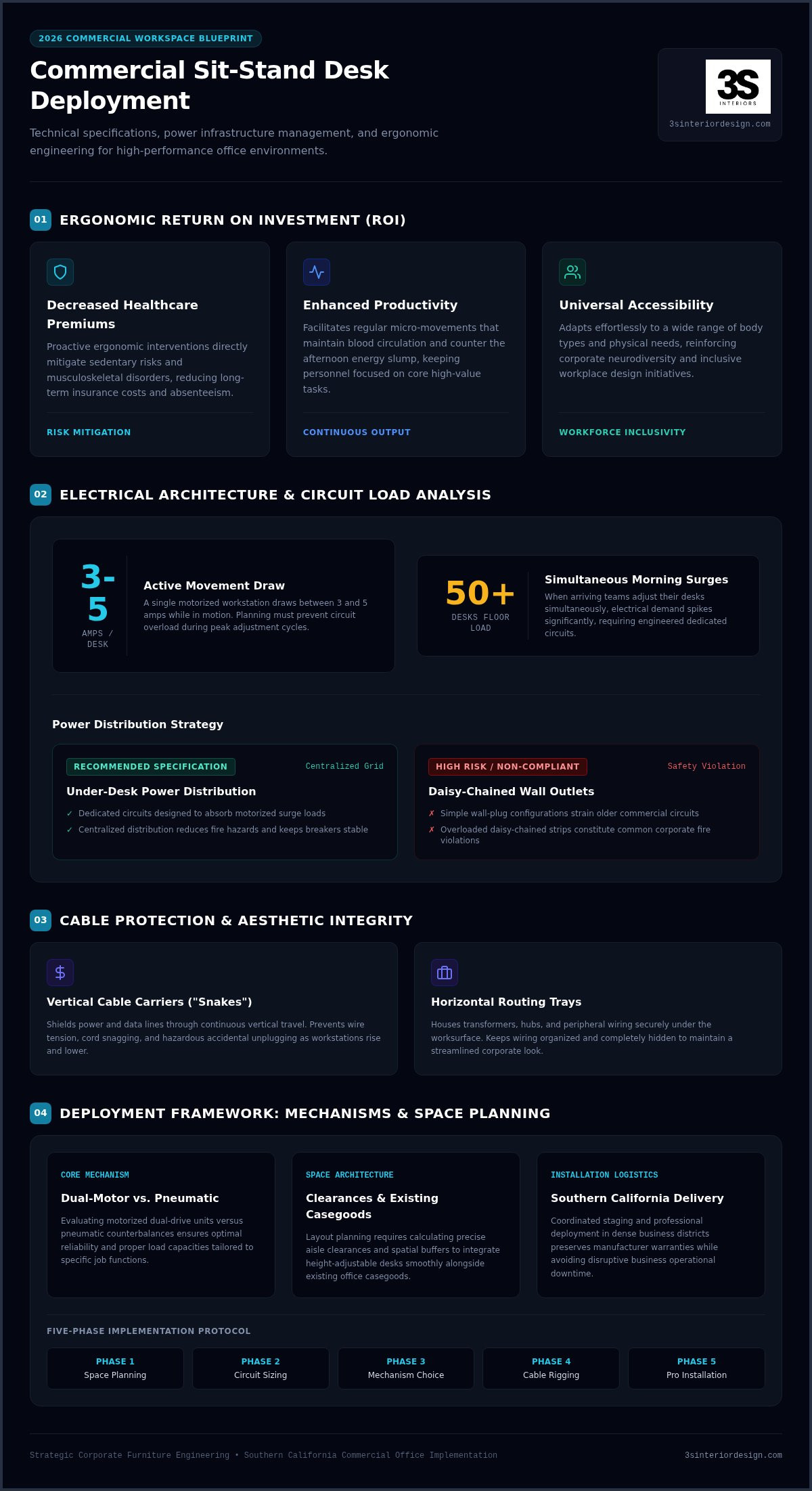
The financial justification for height-adjustable furniture extends beyond simple employee satisfaction. Sedentary behavior is a documented risk factor for musculoskeletal disorders, which often lead to costly workplace injury claims. Providing a sit stand desk for commercial office use allows for micro-movements that maintain circulation and reduce physical fatigue. These small changes in posture lead to significant long-term gains in organizational health.
Decreased healthcare premiums: Proactive ergonomic interventions can lower long-term insurance costs and reduce absenteeism.
Enhanced productivity: Regular movement prevents the afternoon energy slump, keeping staff focused on high-value tasks.
Universal accessibility: These desks accommodate a wider range of body types and physical needs, supporting corporate neurodiversity and inclusivity initiatives.
Strategic planning ensures these benefits are realized without compromising the office's professional aesthetic or electrical integrity. When you treat furniture as a strategic asset, the return on investment manifests in a more resilient and productive workforce. A well-executed sit-stand deployment reduces professional risk by addressing ergonomic health before it becomes a liability issue.
Technical Specifications: Power, Load Capacity, and Cable Management
Integrating a sit stand desk for commercial office environments requires a shift in how facility managers view furniture. These units aren't just tables; they are motorized assets that draw power and house sensitive technology. Failing to account for electrical loads can lead to tripped breakers during peak transition times, such as when a team arrives in the morning and adjusts their workstations simultaneously. Technical planning must precede procurement to ensure the building infrastructure can support the new equipment.
Managing the Power Grid for Motorized Furniture
Calculating total amperage is a critical first step for any large-scale deployment. While a single desk might only draw 3 to 5 amps during movement, a floor of 50 desks can surge significantly if activated at the same time. Professional build-outs often require dedicated circuits to handle this load safely. You should prioritize under-desk power distribution systems over simple wall-plug configurations. This approach centralizes power and reduces the risk of overloaded daisy-chained strips, which are a common fire safety violation in corporate settings.
Professional Cable Management Solutions
Maintaining a clean aesthetic is impossible without robust cable management. High-end workstations utilize vertical cable carriers, often called snakes, and horizontal trays to protect wires as the desk moves. This infrastructure prevents cord strain and ensures compliance with workplace ergonomics guidelines by removing trip hazards and protecting data integrity. Integrated power strips mounted directly to the desk frame allow for a single power cord to exit the unit, which simplifies the overall floor plan and reduces clutter.
Executive setups often involve triple-monitor arms and heavy CPU mounts that require high-torque motors. You must verify that the lift capacity of the sit stand desk for commercial office use exceeds the total weight of the surface and all mounted equipment. Beyond weight, consider the acoustic impact on the office environment. Modern dual-motor systems should operate below 50 decibels. This ensures that height adjustments don't disrupt the focus of nearby colleagues in open-plan environments or during confidential meetings.
Successful implementation depends on precise coordination between furniture specs and facility infrastructure. For help aligning these technical requirements with your specific floor plan, our team provides comprehensive Space Planning & Layout Design services to ensure a seamless and reliable installation.
Evaluating Height-Adjustable Table Mechanisms for Corporate Use
Selecting the appropriate mechanism for a sit stand desk for commercial office environments is a critical decision that influences long-term reliability and user adoption rates. The mechanism determines the speed of adjustment, the weight capacity, and the overall noise profile of the workstation. While several options exist, corporate standards typically focus on systems that balance mechanical durability with ease of use. Understanding these technical differences allows procurement teams to match the right furniture to specific professional roles and office layouts.
Electric dual-motor systems: These represent the industry standard for high-performance workstations. Dual motors provide synchronized lifting power, ensuring the desk surface remains level even under uneven loads.
Pneumatic (counterbalance) desks: These utilize a gas cylinder to facilitate rapid height changes. They operate without electricity, making them ideal for mobile workstations or areas with limited floor power.
Manual crank systems: These are entry-level solutions. While cost-effective, they are rarely recommended for high-frequency use because the physical effort required often leads to employees leaving the desk in a static position.
Electric vs. Pneumatic: A Commercial Comparison
Electric desks offer superior weight capacity and precision but require a constant power source. They are best suited for permanent private offices or designated cubicles where multi-monitor setups are common. Pneumatic desks offer the fastest transition speed, adjusting in seconds with a simple lever. However, pneumatic systems have strict weight limits; adding or removing equipment can require manual tension adjustments to maintain the counterbalance. To ensure compliance with OSHA ergonomics standards, facility managers must verify that the chosen mechanism supports the specific equipment load of each department without requiring excessive force from the user.
Controller Features and User Experience
The interface of a sit stand desk for commercial office use significantly impacts how often staff actually use the height-adjustment feature. Basic up and down toggles are functional but often lead to inconsistent posture. Programmable memory controllers allow users to save their ideal sitting and standing heights, facilitating a one-touch transition that encourages movement throughout the day. This feature is particularly valuable in hybrid offices where multiple employees may share the same workstation across different shifts.
Safety is another non-negotiable requirement in the professional setting. High-quality electric desks include collision detection technology. This system automatically stops and reverses the motor if the desk hits an obstruction, such as a chair arm or a filing cabinet. In high-tech environments, digital displays and Bluetooth-enabled controllers provide usage data that can help organizations track the ROI of their ergonomic investments. These technical refinements ensure the furniture integrates seamlessly into the broader corporate infrastructure.
Space Planning and Implementation for Dynamic Workspaces
Planning the layout for a sit stand desk for commercial office environments requires more than just measuring floor dimensions. It involves managing the dynamic spatial volume occupied by desks at varying heights. A standard static layout doesn't account for the visual and acoustic shifts that occur when half the staff is standing while the other half is seated. Successful implementation requires a methodical approach to aisle clearance, ensuring that movement doesn't obstruct pedestrian traffic or violate safety codes. When workstations are in motion, the safety perimeter around each desk must be strictly maintained to prevent collisions with adjacent furniture or personnel.
Designing for Height Variability
When workstations operate at different elevations, it creates a visual chaos that can detract from a professional aesthetic. You can mitigate this by using consistent finishes and integrating privacy screens that travel with the desk surface. These screens provide a unified sightline regardless of individual desk height, maintaining a clean look across the office floor. Additionally, planners must account for overhead storage and wall-mounted items. A desk rising into a shelf or a monitor arm hitting a low-hanging light fixture is a common logistical failure that professional planning prevents. We ensure that every sit stand desk for commercial office use has the necessary vertical clearance to operate safely within the existing architecture.
The Role of Professional Space Planning
Precision is mandatory when balancing high-density floor plans with the ergonomic movement zones required for height-adjustable furniture. We utilize CAD and 3D modeling to visualize how these dynamic workstations interact with existing private office casegoods and storage systems. This technical assessment identifies potential bottlenecks before furniture is even ordered. You can learn more about our office space planning services to see how we manage these complex spatial requirements for corporate clients.
Acoustic planning is equally vital in dynamic environments. In open-plan layouts, sound travels differently when employees are standing, as their voices are no longer dampened by traditional seated-height partitions. Strategic placement of acoustic panels and the use of sound-masking technology can maintain a quiet, professional atmosphere. For large firms in Southern California, we often recommend a phased implementation strategy. This allows for logistical testing of power loads and spatial flow in a controlled area before a full-campus rollout. This methodical approach reduces operational risk and ensures that the final installation meets the high standards of a professional workspace. To secure a floor plan that maximizes both density and employee wellness, contact our team for a professional Space Planning & Layout Design consultation.
Procurement and Professional Installation in Southern California
Procuring a sit stand desk for commercial office use at scale involves complex logistical coordination that goes beyond simple furniture delivery. It isn't a retail transaction; it's a technical deployment that requires professional oversight. Professional installation is mandatory for maintaining manufacturer warranties and ensuring operational safety across a large floor plan. Our turnkey project management model oversees every phase, from initial procurement to the final walkthrough, which reduces the administrative burden on your facility team and ensures a consistent standard of quality.
Local Logistical Expertise in Los Angeles
Operating in high-density markets like Century City, Santa Monica, or Irvine presents unique challenges for furniture delivery. Building management in these areas often enforces strict delivery windows and requires specific insurance certifications for onsite contractors. We manage these details by coordinating freight elevator access and navigating restricted loading zones in high-traffic areas like Beverly Hills. This local knowledge prevents costly delays and ensures that your project remains on schedule without disrupting other tenants. You can explore our detailed approach to turnkey workspace solutions in Los Angeles to understand how we mitigate these urban logistical risks.
The 3S Interior Design Installation Advantage
Our specialized installation team performs technical checks that general movers or assembly services cannot provide. For motorized workstations, precision leveling is essential. An unlevel desk puts uneven strain on the lift mechanism, which often leads to premature motor failure and voided warranties. We conduct comprehensive power testing for every unit to verify that the electrical load remains within the building's calculated capacity. During this phase, we also focus on integrating ergonomic task chairs with the new workstations to create a cohesive, high-performance environment that meets professional standards.
Deployment doesn't end when the desks are assembled. We provide a final project walkthrough to ensure every sit stand desk for commercial office use meets our strict quality benchmarks. This process includes a brief orientation for your staff on how to operate the programmable controllers and adjust their workstations for optimal posture. This post-installation support ensures that your investment in ergonomic furniture translates into actual usage and improved employee wellness ROI. By managing the transition from procurement to daily operation, we provide the stability and reliability required for a successful corporate workspace redesign.
Strategic Implementation for Your 2026 Workspace
Successful integration of a sit stand desk for commercial office environments depends on aligning technical infrastructure with precise spatial planning. Managing electrical loads and maintaining vertical clearance are just as critical as selecting the right motorized mechanism. These logistical details ensure that your furniture investment delivers long-term wellness ROI without compromising operational stability or building safety. A methodical approach to these specifications prevents the common pitfalls of power surges and cluttered floor plans that often plague unmanaged deployments.
3S Interior Design has served Los Angeles and Orange County for over a decade. We specialize in high-capacity commercial furniture deployments, providing comprehensive project management from the initial floor plan to the final technical walkthrough. Our expertise ensures that your transition to dynamic workstations is seamless, professional, and fully compliant with warranty requirements. We take pride in managing the complex logistical details that others might find overwhelming.
Ready to modernize your corporate environment? Request a Consultation for Your Turnkey Office Project today. We look forward to helping you build a more resilient and productive workspace that supports your team's success for years to come.
Frequently Asked Questions
Do sit-stand desks require special electrical wiring in commercial buildings?
Standard motorized desks typically run on 120V power, but large-scale deployments require a detailed load assessment. You don't necessarily need custom wiring, but you must avoid overloading existing circuits. A single sit stand desk for commercial office use draws minimal power while static, but simultaneous motor activation can surge. Our space planning team calculates these requirements to ensure your building's electrical infrastructure remains stable during peak transition times.
What is the ideal ratio of sit-stand desks to static desks in a large office?
Modern workspace standards for 2026 favor a 1:1 ratio for all new workstations. While some firms previously used a mix, providing height-adjustable options to every employee is now a standard requirement for recruitment and retention. This universal approach simplifies space planning and ensures that every staff member has access to the same ergonomic benefits. It also prevents the logistical complexity of managing two different types of furniture inventory as your team scales.
How do height-adjustable tables affect office acoustics?
Height-adjustable desks alter sound reflection patterns because standing employees project their voices above traditional seated-height partitions. This shift can increase noise levels in open-plan environments if not managed correctly. We recommend integrating desktop privacy screens that move with the surface to provide consistent sound absorption. Strategic use of acoustic panels and sound-masking technology also helps maintain a quiet, professional atmosphere as users transition between sitting and standing heights.
What is the average lifespan of an electric commercial-grade sit-stand desk?
Commercial-grade electric desks typically offer a lifespan of 5 to 10 years for motorized components and much longer for the frame. Longevity depends on the motor's duty cycle and the quality of the internal lifting columns. Professional installation is vital for maximizing this lifespan. Precision leveling prevents uneven wear on the motors, while regular power testing ensures the electronics aren't damaged by building power fluctuations.
Can I retrofit my existing private office casegoods with sit-stand mechanisms?
Retrofitting is possible but requires a technical evaluation of your existing private office casegoods. The original desktop must be compatible with a new height-adjustable base in terms of weight, thickness, and dimensions. Many high-end wood veneers are heavy, requiring a dual-motor system with high torque. We assess your current furniture to determine if a mechanism upgrade is more cost-effective than a complete replacement while ensuring the final result meets professional standards.
Are pneumatic sit-stand desks better than electric for open-plan offices?
Pneumatic desks are often better for agile spaces or areas without easy access to floor power. They allow for rapid height changes without cords, which reduces clutter in open-plan offices. However, electric desks remain the standard for high-capacity workstations with multiple monitors and heavy equipment. Electric systems provide more precise control and higher lift capacities, making them the preferred choice for permanent workstations where technical performance is the priority.
How much weight can a professional commercial sit-stand desk typically hold?
A professional sit stand desk for commercial office use typically supports between 200 and 350 pounds. This capacity must account for the weight of the desktop itself, monitor arms, triple-screen setups, and heavy CPUs. High-torque dual-motor systems handle these loads with minimal noise and consistent speed. Exceeding these limits can strain the motors and void your warranty, so we always verify your equipment requirements during the procurement phase.
Does 3S Interior Design provide installation for businesses in Orange County?
Yes, 3S Interior Design provides comprehensive installation services across Orange County, including major business hubs like Irvine and Pomona. Our local expertise allows us to manage the specific logistical requirements of OC office parks and high-rise developments. We handle everything from the initial space planning and product selection to the final delivery and technical walkthrough. This turnkey model ensures your project is executed with precision regardless of its location in Southern California.


Comments