


Commercial Office Storage Solutions in San Diego: The 2026 Strategic Procurement Guide
- amber7624
- 3 days ago
- 12 min read
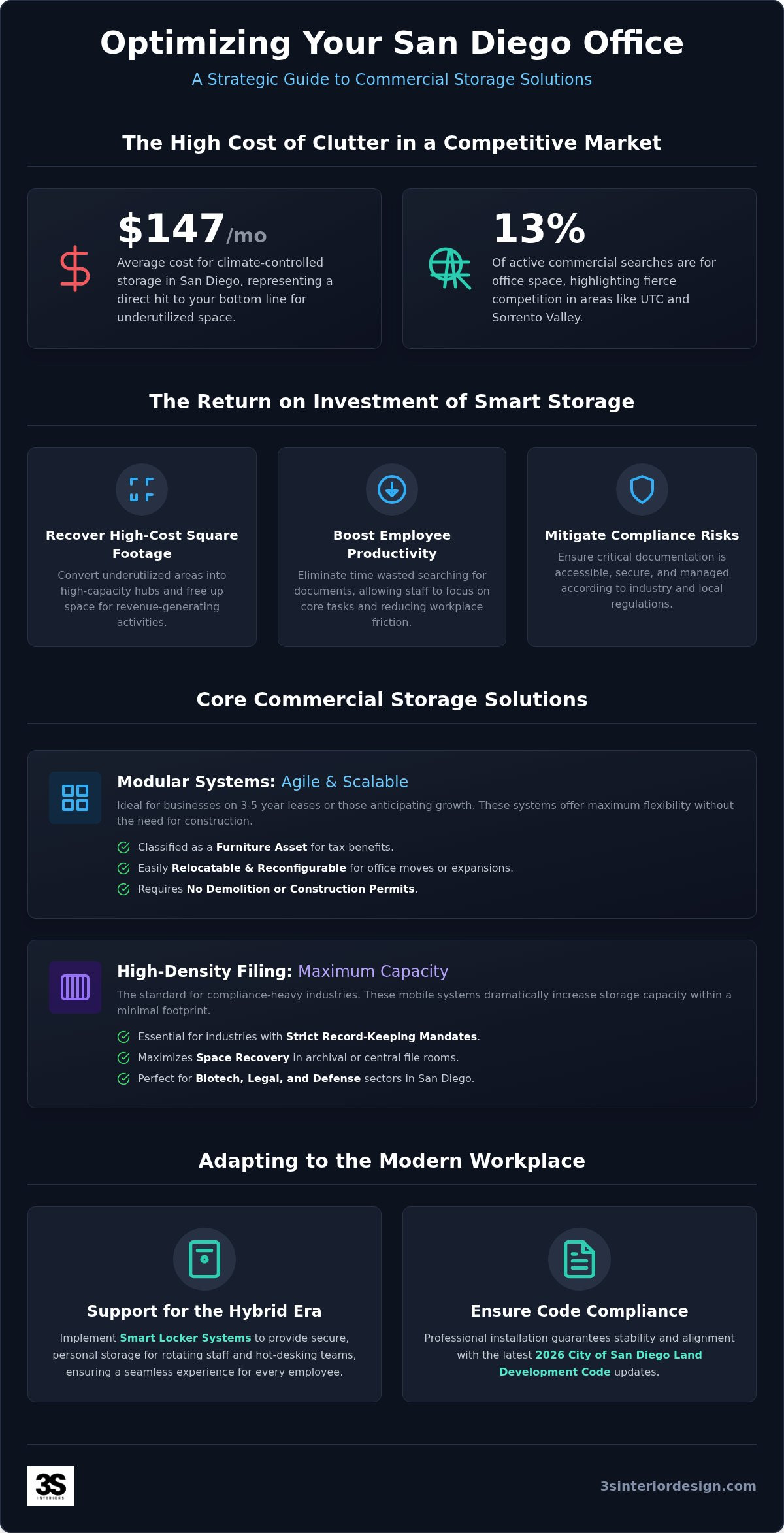
Every square foot of your San Diego office represents a significant capital investment, yet many firms continue to pay premium rates for space occupied by disorganized paperwork and legacy equipment. With the average cost of climate-controlled storage in the region reaching $147 monthly as of April 2026, the financial incentive to optimize your internal footprint has never been higher. Identifying the right commercial office storage solutions San Diego businesses need to remain competitive is no longer a matter of aesthetics; it's a critical logistical strategy for maximizing your real estate ROI.
You likely understand that a cluttered workspace reduces employee productivity and creates unnecessary compliance risks. This 2026 strategic procurement guide provides a methodical framework for transforming your office into a highly organized, professional environment. We'll outline how to increase your storage capacity without expanding your physical footprint, ensuring your furniture selections meet the latest 2026 City of San Diego Land Development Code updates. From high-density filing systems to durable modular casegoods, you'll learn to select commercial-grade solutions that support long-term operational success.
Table of Contents
Maximizing Real Estate ROI: The Role of Strategic Office Storage in San Diego
In the San Diego commercial market, real estate costs often dictate operational boundaries. High-demand areas like the UTC corridor and Sorrento Valley command premium lease rates, making every square foot a high-stakes investment. Businesses that fail to optimize their floor plans effectively pay a clutter tax on every underutilized area. Strategic commercial office storage solutions San Diego companies implement act as a hedge against these rising property costs. By treating storage as a core component of space planning rather than an afterthought, firms can reduce their total required footprint while maintaining full operational capacity. According to 2026 market data, the office sector accounts for nearly 13% of active commercial searches in the region, indicating a competitive environment where efficiency is a necessity for financial stability.
Effective logistics require a clear distinction between active and archival storage. Active storage houses high-frequency items like current project files and daily-use supplies within the immediate reach of workstations. This ensures that employees don't waste time navigating the office for essential tools. Archival storage focuses on long-term records and seasonal equipment, often utilizing high-density systems in less central areas of the office. This segmentation ensures that primary workspace remains dedicated to high-value employee activity rather than housing static inventory.
The High Cost of Clutter in Modern Workspaces
Wasted space in premium districts represents a direct hit to the bottom line. Disorganized environments do more than just occupy space; they actively degrade employee focus and hinder talent retention. When staff spend time searching for misplaced documents or navigating crowded corridors, productivity drops significantly. Professional storage systems deliver a measurable return on investment by reclaiming high-cost square footage for revenue-generating activities. This methodical approach to organization mitigates professional risk by ensuring that critical documentation remains accessible and secure.
Balancing Aesthetics with Operational Efficiency
Modern storage systems must integrate seamlessly with a firm’s branding and overall interior design. The industry has moved away from the bulky, standalone metal cabinets of the past in favor of integrated casegoods that provide a streamlined, polished look. It's essential to select private office desks and casegoods that offer built-in storage capabilities to maintain a clean aesthetic across the floor plan. This approach ensures that the office reflects brand professionalism while meeting strict technical specifications for durability. Using a strategic partner to plan these systems ensures coordination between functional needs and the visual standards expected in high-level corporate environments.
Core Types of Commercial Office Storage Solutions
Selecting the right hardware is a logistical decision that impacts daily workflow and long-term facility costs. For the diverse business ecosystem in Southern California, the commercial office storage solutions San Diego firms select must balance immediate access with spatial efficiency. This selection process begins with identifying the specific density requirements of your industry, whether you're managing a high-growth tech startup or a traditional legal practice. Each hardware type offers specific advantages for different operational scales and professional environments.
Modular vs. Built-In Storage: Which is Right for Your Lease?
Modular systems offer a distinct advantage for businesses operating on three-to-five-year leases. Unlike permanent built-in cabinets, modular units are classified as furniture assets rather than tenant improvements (TI). This distinction allows for potential tax depreciation benefits and the ability to relocate the entire system during an office expansion or move. Reconfiguring modular systems doesn't require demolition or construction permits, ensuring your operations remain agile as your team grows. For startups in San Diego's tech hubs, this flexibility is essential for maintaining a low-risk, high-efficiency workspace.
High-Density Filing for Compliance-Heavy Industries
For industries with strict record-keeping mandates, high-density mobile filing is the standard for maximizing space recovery. These systems place shelving units on tracks, eliminating the need for multiple fixed aisles. By utilizing a single moving aisle, you can double your storage capacity within the exact same square footage. When evaluating these systems, it's helpful to review the commercial filing systems Los Angeles procurement guide for technical specifications on weight distribution and floor loading. Professional installation is mandatory for these systems to ensure safety and compliance with California's seismic requirements.
Beyond high-density systems, choosing between lateral and vertical file cabinets depends on your specific floor plan constraints. Lateral cabinets provide a wider footprint and can serve as secondary work surfaces or space dividers in open-plan offices. Vertical cabinets are better suited for narrow alcoves where horizontal floor space is at a premium. In executive environments, pedestal units and credenzas offer secure, low-profile storage that integrates seamlessly with private office desks. If you're unsure which configuration fits your specific floor plan, our team provides comprehensive space planning and layout design to identify the most efficient storage strategy for your facility.
Storage for the Hybrid Era: Lockers and Personal Storage Systems
The transition to hybrid work models has redefined the requirements for personal storage within the modern office. San Diego’s competitive professional districts see many firms adopting "hot-desking" or hoteling strategies to maximize floor plan efficiency. This shift renders the traditional fixed desk drawer obsolete for much of the workforce. Companies are now implementing centralized personal storage systems that provide security for employees while maintaining an organized, flexible floor plan. Selecting the right commercial office storage solutions San Diego professionals need involves evaluating how shared access impacts daily traffic flow and logistical coordination.
Integrating these systems into communal "neighborhood" zones allows teams to maintain a sense of belonging without requiring dedicated square footage for every individual. This approach transitions the office from a collection of static desks to a dynamic environment where storage is a centralized service. By moving personal items to the periphery or designated zones, firms reclaim valuable floor space for collaborative areas or additional workstations. Many firms don't realize that transitioning to centralized banks can reduce the total storage footprint significantly while improving the overall aesthetic of the workspace.
Smart Lockers: Security and Management in 2026
Digital locking systems have transformed facility management by automating the assignment and tracking of personal storage units. Modern smart lockers utilize RFID or mobile app integration, allowing employees to secure their belongings at any available unit without the need for physical keys. This technology provides facility managers with real-time data on locker utilization, helping them optimize the number of units required based on actual office attendance. Centralized locker banks support a strict clean-desk policy by ensuring all personal items are removed from common work surfaces at the end of each shift. These systems are available in various finishes that allow them to blend seamlessly into the architectural design of the office.
Mobile Pedestals: The Flexible Companion for Agile Teams
For teams that require high mobility within the office, "caddy" style mobile pedestals offer a versatile alternative to fixed cabinetry. These units are designed to follow the employee to different workstations, providing a consistent point of access for essential tools and documents. Many modern designs feature cushioned tops, allowing the unit to serve as a secondary seating option for quick collaborative sessions at a workstation. These versatile units pair effectively with ergonomic task chairs vs executive chairs to create a complete, high-performance workstation setup that adapts to the needs of agile workers.
Industry-Specific Storage Requirements in San Diego
Professional storage requirements vary significantly across San Diego’s diverse economic sectors. A law firm in a Downtown high-rise has different logistical needs than a life sciences startup in Torrey Pines. Identifying the specific commercial office storage solutions San Diego businesses require involves understanding the regulatory and operational constraints of each field. Defense contractors must prioritize security and fire ratings, while creative agencies often require open-access systems for material libraries and physical samples. A methodical approach to procurement ensures that your storage infrastructure supports your specific industry's workflow.
Sorrento Valley Tech & Biotech Storage Needs
Biotech firms in Sorrento Valley require storage systems that withstand the rigorous demands of lab-adjacent office spaces. Materials must be durable and easy to sanitize to maintain facility standards. These environments often utilize modular cabinetry that can house sensitive documentation alongside specialized technical equipment. Integrating these storage units with adjustable height tables ensures that researchers can maintain ergonomic efficiency while accessing critical tools. This coordination between workstation design and storage placement is vital for maintaining high-performance lab environments.
Downtown Legal Firms: Archival and Active Case Storage
Legal and financial services in Downtown San Diego face the challenge of managing massive physical file volumes within the constraints of high-rise floor plans. These firms require a balance between high-density filing and executive aesthetics that reflect the brand's prestige. Secure locking mechanisms are mandatory to protect sensitive client data and meet professional compliance standards. Space planning in these environments often involves evaluating floor load capacities to support the weight of high-density mobile systems. Effective layout design ensures that active case files remain accessible while archival records are stored efficiently.
Defense and government contractors operating near San Diego’s military hubs have even stricter requirements. These facilities often need fire-rated storage and secure solutions that complement SCIF (Sensitive Compartmented Information Facility) environments. Every storage selection must meet specific technical specifications to ensure data integrity and physical security. If your organization operates in a specialized sector, our team provides the turnkey storage and filing systems necessary to meet your industry's unique logistical demands.
Turnkey Execution: Planning and Installing Your San Diego Storage
Successful implementation of the commercial office storage solutions San Diego businesses invest in depends on logistical precision. Procuring high-quality hardware is only the first step; the true value lies in the methodical coordination of delivery and assembly. 3S Interior Design manages this entire lifecycle through a structured project timeline that moves from initial assessment to the final walkthrough. This end-to-end approach ensures that every storage unit is placed according to the strategic floor plan, minimizing the risk of operational bottlenecks during the transition.
Professional installation is a technical necessity for heavy-duty filing and modular systems. These units often require precise leveling and seismic anchoring to comply with local safety standards and 2026 building codes. Our team coordinates directly with facility managers to schedule deliveries during off-peak hours, reducing business disruption in busy commercial districts. By acting as a single point of contact for procurement and installation, we eliminate the communication gaps that often occur when using multiple vendors. This logistical reliability provides corporate decision-makers with the security that their project will be completed on schedule and within technical specifications.
The Logistics of a Seamless Storage Rollout
Managing delivery schedules in Southern California requires deep local expertise to navigate regional traffic patterns and building access restrictions. We monitor manufacturer lead times closely to ensure that modular systems arrive exactly when the site is prepared for installation. Our safety protocols for vertical and high-density systems prioritize the structural integrity of your facility and the safety of your staff. 3S Interior Design handles the heavy lifting of coordination, allowing your leadership team to remain focused on core business activities while we manage the physical transformation of the workspace.
Strategic Space Planning for Storage ROI
Visualizing storage capacity before a single unit is purchased is essential for maximizing your real estate investment. We utilize detailed 2D and 3D layouts to demonstrate exactly how new systems will integrate with your existing furniture and workflow. This planning phase is critical for ensuring ADA compliance and maintaining proper egress in storage-heavy areas. Utilizing professional office space planning services allows you to identify opportunities for space recovery that aren't immediately obvious. This methodical visualization ensures that the final installation delivers the highest possible capacity without compromising the office's aesthetic or functional flow.
Our commitment to your project continues beyond the final walkthrough. We provide post-installation support and help you plan for future scalability as your San Diego team grows. Whether you need to reconfigure modular units for a new department or expand your high-density filing, our long-term mindset ensures your storage infrastructure remains a stable asset for decades.
Optimizing Your Workspace for Long-Term Operational Stability
Strategic storage is more than a logistical necessity; it's a financial tool for reclaiming high-cost square footage in Southern California's competitive business districts. By transitioning from static cabinets to modular systems and high-density filing, firms reclaim valuable floor space while ensuring compliance with 2026 local building codes. Whether you're managing a Sorrento Valley biotech lab or a Downtown legal practice, your storage infrastructure must balance immediate access with long-term scalability. Implementing the right commercial office storage solutions San Diego firms need requires a methodical approach that combines expert space planning with technical precision.
3S Interior Design provides end-to-end project management and manufacturer-agnostic product selection to ensure your facility remains organized, compliant, and efficient for decades. Our team specializes in managing the complex logistics of procurement and coordination specifically for Southern California business hubs. We focus on the details that ensure your furniture serves as a stable foundation for your daily operations. Consult with our San Diego workspace experts to optimize your storage ROI today. Taking this step toward a more organized office will secure your operational stability and reflect your brand's commitment to professional standards.
Frequently Asked Questions
What is the most space-efficient filing system for a small San Diego office?
High-density mobile filing systems are the most space-efficient option for smaller office footprints. These systems mount shelving units on tracks to eliminate wasted aisle space, potentially doubling your capacity within the same area. For San Diego firms in high-rent districts, this optimization is a critical logistical move. You should evaluate your floor load capacity early in the planning phase to ensure the building structure supports the concentrated weight of high-capacity units.
Do I need a permit for high-density mobile filing installation in California?
High-density mobile filing systems typically require building permits because they impact floor loading and must meet strict seismic anchoring standards. The 2025 California Building Standards Code, which took effect in January 2026, mandates specific safety protocols for heavy equipment. Professional installers coordinate with structural engineers to ensure the system is anchored correctly, mitigating risks during seismic events and ensuring full compliance with local safety regulations and land use policies.
How much does professional office storage installation cost in San Diego?
Professional installation costs are determined by logistical variables such as system complexity, site access, and floor level. Factors like floor reinforcement for high-density units or after-hours delivery requirements in San Diego business districts influence the project scope. We provide end-to-end coordination to manage these variables, ensuring the installation meets technical specifications. Every project is unique, so we focus on providing a reliable delivery schedule that minimizes disruption to your daily operations.
Can commercial storage systems be reconfigured if our office layout changes?
Modular commercial office storage solutions San Diego businesses utilize are designed specifically for reconfiguration. These units are not permanently attached to the building structure, allowing you to move or expand them as your team grows. This flexibility makes modular systems a superior long-term investment compared to custom built-in cabinetry. When your lease ends or your department scales, you can relocate these assets to a new facility, preserving your initial capital investment.
What are the best storage solutions for a hybrid "hot-desking" office?
Hybrid environments function best with a combination of smart lockers and mobile pedestals. Smart lockers provide secure, temporary storage for employees who don't have a dedicated desk, while mobile pedestals allow staff to move their essential tools between different workstations. This strategy supports a clean-desk policy and ensures that communal areas remain organized. Centralizing storage in this manner allows you to reduce the total number of storage units required for your actual daily headcount.
How do I choose between laminate and metal storage cabinets for a professional setting?
Metal cabinets offer maximum durability and higher weight capacities, making them ideal for high-volume archival storage or back-office environments. Laminate systems provide a more polished aesthetic that integrates well with executive desks and reception areas. Your choice should depend on the specific technical specifications of the items you're storing and the visual standards of the workspace. Many firms use a hybrid approach, placing laminate units in client-facing areas and metal systems in secure records rooms.
Is there a difference between "contract-grade" storage and retail office furniture?
Contract-grade storage is engineered to meet rigorous BIFMA standards for safety, durability, and load-bearing capacity in high-use professional environments. Retail furniture often lacks the structural reinforcement necessary for heavy-duty filing or long-term professional use. Investing in contract-grade commercial office storage solutions San Diego professionals trust ensures that your furniture remains functional for decades. These systems also carry comprehensive commercial warranties that cover the high-frequency usage typical in professional office settings, providing long-term operational security.
How does storage planning impact my overall office furniture budget?
Strategic storage planning identifies opportunities to reduce your total square footage, which can significantly lower your long-term lease expenses. By integrating storage into your workstations or using high-density systems, you reduce the need for additional square footage dedicated to filing rooms. This optimization allows you to allocate more of your budget toward high-quality ergonomic seating or collaborative technology. Effective planning ensures that every furniture purchase contributes directly to the operational efficiency and financial success of your facility.


Comments