


Ergonomic Office Furniture ROI: The 2026 Facility Manager’s Guide
- amber7624
- 4 days ago
- 12 min read
A premium ergonomic chair isn't a luxury perk; it's a high-yield financial instrument that mitigates the rising costs of workplace absenteeism. Facility managers in Los Angeles and Orange County frequently face budget pushback when proposing high-end workstations, yet the cost of physical discomfort and musculoskeletal disorders continues to erode the bottom line. You likely recognize that your team's performance is directly tied to their physical environment, but justifying the initial expense requires a focus on more than just comfort. Calculating a precise ergonomic office furniture ROI involves analyzing long-term productivity gains and the reduction of operational risks.
This guide provides the data-backed framework you need to secure leadership approval for premium investments. We'll examine how to quantify the financial returns of ergonomic seating and height-adjustable tables while navigating the logistical complexities of Southern California procurement. You will learn to streamline project management through turnkey installation services and leverage the latest BIFMA G8.1-2026 standards to protect your facility. From risk mitigation to end-to-end execution, we're outlining the strategic path to a more efficient and high-performing workspace.
Table of Contents
What is Ergonomic Office Furniture ROI?
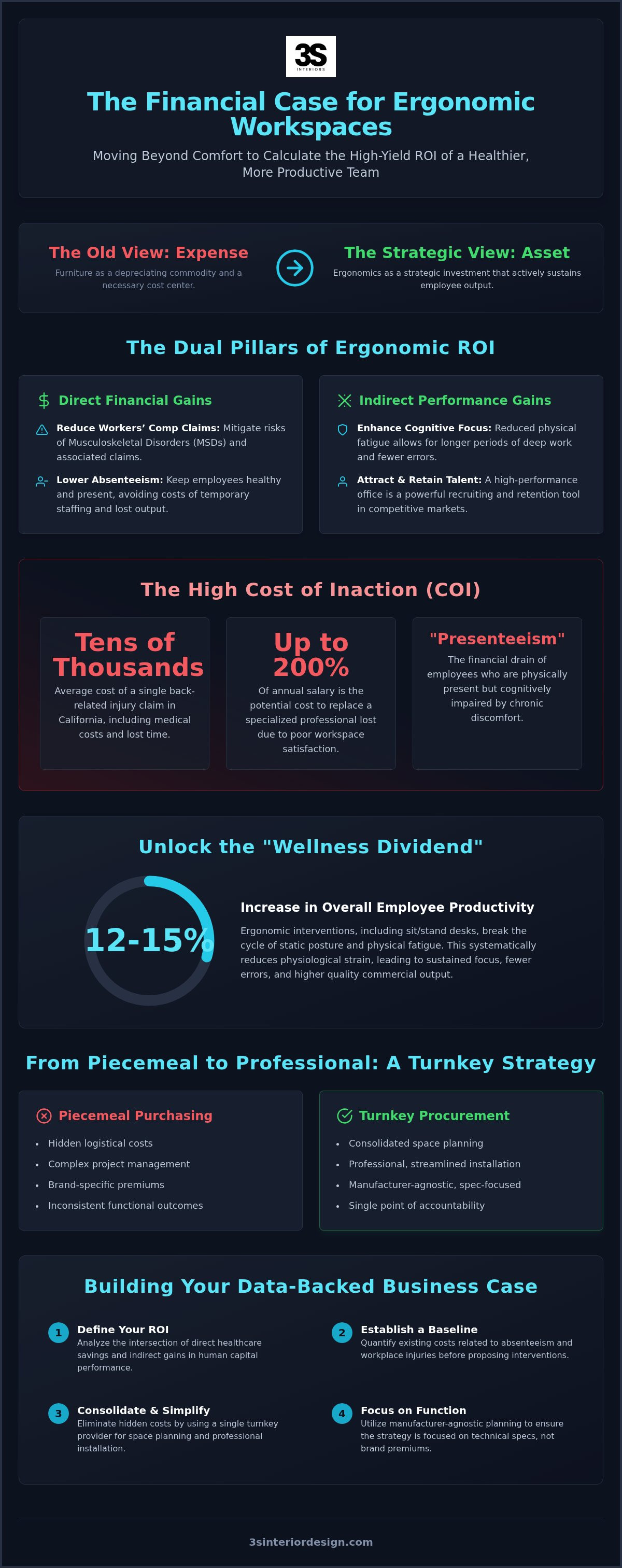
In the 2026 corporate environment, ergonomic office furniture ROI is defined as the measurable financial gain derived from optimized human capital performance and the mitigation of operational risks. This metric moves beyond the initial procurement cost to evaluate how physical assets influence the bottom line over their functional lifespan. To understand the full scope of these returns, one must first ask: What is Ergonomics? At its core, it's the science of designing the workplace to fit the user. When applied to facility management, it transforms furniture from a depreciating commodity into a strategic asset.
The 2026 "Performance Lifecycle" concept emphasizes that commercial-grade assets must do more than just last; they must actively sustain employee output. For businesses in Southern California, where workplace standards and wellness expectations are exceptionally high, failing to meet these benchmarks can lead to significant financial leakage. A methodical approach to procurement ensures that every workstation and task chair contributes to a broader framework of corporate efficiency.
Direct vs. Indirect ROI Factors
Calculating a precise ergonomic office furniture ROI requires a clear distinction between direct and indirect financial drivers. Direct ROI is often the easiest to track through existing HR and insurance data. It focuses on the reduction of workers’ compensation claims and lower rates of absenteeism specifically related to Musculoskeletal Disorders (MSDs). When an employee remains healthy and present, the company avoids the immediate costs of medical payouts and temporary staffing.
Indirect ROI factors are equally critical but require more nuanced quantification for budget approval. These include:
Enhanced Cognitive Focus: Reducing physical fatigue allows for longer periods of deep work and fewer errors.
Talent Acquisition: In competitive markets like Santa Monica and Irvine, a high-performance office environment serves as a powerful recruiting tool.
Reduced Task-Switching: Intuitive, adjustable workstations minimize the time employees spend fidgeting or adjusting their equipment, leading to smoother workflows.
The Cost of Inaction (COI)
The financial drain of "presenteeism", where employees are physically present but cognitively impaired by chronic pain, is often higher than the cost of a full upgrade. Industry data suggests that the average cost of a single back-related injury claim in California can reach tens of thousands of dollars when including medical costs and lost time. Beyond the immediate injury, poor workspace satisfaction leads to the long-term cost of replacing high-value talent. Replacing a specialized professional can cost up to double their annual salary. Investing in ergonomic infrastructure is a proactive measure to protect your most expensive asset: your people.
Quantifying Productivity Gains and Reduced Operational Risk
The financial justification for high-performance furniture relies on Quantifying Productivity Gains through the systematic reduction of physiological strain. Static postures lead to restricted blood flow and muscle fatigue, which directly correlate with cognitive decline and increased error rates. Scientific benchmarks for 2026 indicate that ergonomic interventions drive a 12% to 15% increase in overall employee productivity. This "Wellness Dividend" represents a tangible shift in corporate office culture where health is treated as a prerequisite for commercial output rather than a secondary benefit.
Physical fatigue acts as a silent tax on corporate performance. When employees struggle with discomfort, their ability to maintain deep focus diminishes, leading to frequent micro-breaks and decreased task accuracy. By providing workstations that support natural body alignment, businesses can sustain higher levels of output throughout the standard eight-hour shift. This optimization is particularly vital for high-density environments in Los Angeles and the Inland Empire, where operational efficiency is the primary driver of competitive advantage.
The Impact of Sit/Stand Desks on Commercial Output
Traditional static desks are becoming a liability in the modern workplace as firms transition to dynamic working environments. A sit stand desk for commercial office use allows employees to alternate between sitting and standing, which prevents the metabolic slowdown associated with sedentary behavior. The ergonomic office furniture ROI for these assets is realized through the gain of approximately 45 to 60 minutes of high-focus work per day per employee. This reclaimed time quickly offsets the procurement cost of height-adjustable tables across large-scale corporate installations. Reclaiming focus minutes translates directly into faster project completion and reduced overtime costs.
Mitigating Musculoskeletal Disorder (MSD) Risk
Preventing repetitive strain is a core component of a modern risk management strategy. Using ergonomic chair standards for corporate wellness ensures that workstations accommodate the full range of your workforce. Technical specifications, such as adjustable lumbar support and armrest pivot, maintain neutral spinal health during intensive data entry or creative tasks. These features aren't just for comfort; they're functional tools that lower the probability of long-term injuries and costly workers' compensation claims.
By integrating these standards, facility managers can effectively insulate the organization from the volatility of medical expenses and lost productivity. If you're looking to optimize your floor plan for peak performance, consider how professional space planning can align your physical assets with your long-term business goals. A methodical approach to seating and desk selection ensures that your ergonomic office furniture ROI remains high throughout the entire lifecycle of the facility.
The Logistical ROI of Turnkey Procurement in Southern California
Piecemeal procurement often masks the true expenditure of a facility upgrade. When facility managers juggle multiple vendors for seating, workstations, and storage, they inherit a fragmented project timeline that invites delays and administrative overlap. True ergonomic office furniture ROI isn't just found in the chair's lumbar support; it's found in the efficiency of the delivery model. Consolidating space planning, procurement, and installation under a single strategic partner eliminates the hidden costs of project management. This turnkey approach is particularly valuable in Southern California. Navigating high-traffic zones like Beverly Hills or Century City requires precise logistical coordination to avoid site-access penalties and idling delivery fees. Facility managers can follow established frameworks for calculating the Return on Investment (ROI), which often highlight how reduced coordination time contributes to the bottom line.
Space Planning: Maximizing Square Footage ROI
Real estate in markets like Irvine or Santa Monica remains a major corporate expense. Professional office space planning services ensure that your floor plan minimizes wasted square footage while maintaining rigorous ergonomic standards. By utilizing modular workstations and benching systems, firms can adapt their layouts as team sizes fluctuate without requiring a complete overhaul of physical assets. This flexibility ensures that the cost-per-square-foot remains optimized throughout the facility's lifecycle. A well-planned layout doesn't just fit more people; it places them in configurations that facilitate workflow and reduce physical fatigue.
Installation Efficiency and Professional Coordination
Relying on general labor for complex furniture assembly often results in damaged components or improper configuration. Professional installation teams understand the technical specifications of height-adjustable tables and ergonomic seating. They ensure every unit is field-tested for immediate use. Turnkey solutions mitigate the risk of delivery delays that can halt corporate operations and lead to lost billable hours. 3S Interior Design provides this end-to-end management across the region, from Burbank to Long Beach. Our methodical approach ensures that your ergonomic office furniture ROI isn't eroded by logistical friction, damaged goods, or site-level mismanagement. Treating furniture procurement as a strategic project rather than a series of individual transactions protects your investment from day one.
How to Calculate ROI on Ergonomic Office Furniture
Transforming procurement from a cost center into a strategic investment requires a methodical five-step calculation. This process moves beyond the initial invoice to reveal the total financial impact of high-performance physical assets. By following this framework, facility managers can present a data-backed business case that aligns with corporate fiscal goals.
Step 1: Baseline Existing Costs. Audit your previous 12 months of data regarding employee absenteeism, healthcare premiums, and turnover rates. These figures represent your current financial leakage.
Step 2: Calculate the Intervention Cost. Total the expenditure for the new assets, including space planning, procurement, and professional installation. This is your gross investment.
Step 3: Estimate Productivity Gains. Apply a conservative productivity increase of 5% to 15%. This range is based on the reduction of physical fatigue and the reclamation of focus minutes discussed in previous sections.
Step 4: Project Asset Lifespan. Commercial-grade ergonomic furniture is designed for durability. Project a functional lifespan of 10 to 15 years for these assets to determine their annualized cost.
Step 5: Compare TCO Against the Dividend. Contrast the annualized Total Cost of Ownership (TCO) against the projected annual productivity dividend to see the net ergonomic office furniture ROI.
Formula for Annual Ergonomic ROI
To simplify the presentation to executive leadership, use the following formula: (Annual Productivity Gain + Healthcare Savings) / Annualized Equipment Cost. This calculation demonstrates the efficiency of the asset over time rather than focusing on the upfront price tag. An ergonomic chair paying for itself in under 18 months is a standard industry benchmark for high-performance workplaces. Differentiating between the initial price tag and long-term asset value is essential for accurate forecasting. While entry-level options might seem cheaper, their shorter lifespans and lower performance benefits often result in a lower net return.
Justifying Premium Seating to Stakeholders
Stakeholders often view furniture as "office decor" rather than a tool for operational efficiency. To shift this perspective, utilize a ergonomic task chairs vs executive chairs comparison to explain value tiers. Frame the purchase as a risk mitigation strategy that protects the organization from the volatility of the Southern California labor market. In competitive regions like Los Angeles, providing high-tier ergonomic support is a retention-focused investment that reduces the high cost of talent replacement. If you're ready to build your business case, consult with our strategic procurement team to obtain precise technical specifications and logistical cost estimates.
Executing Your High-ROI Workspace Strategy
Executing a successful furniture strategy requires moving beyond theoretical calculations into a structured implementation phase. A methodical approach ensures that your ergonomic office furniture ROI is realized through precise asset selection and professional execution. Partnering with a manufacturer-agnostic firm allows for a planning process focused on technical specifications rather than brand loyalty. This objectivity ensures the final procurement fits the specific functional needs of your workforce while adhering to the established budget. It's a strategic shift that prioritizes long-term operational stability over short-term savings.
Audit Your Current Workspace
A comprehensive audit is the first step in identifying "red flag" zones where outdated furniture is actively costing the organization money. These zones are often characterized by high rates of reported discomfort or visible improvisations by staff, such as using external cushions for lumbar support. Employee surveys provide qualitative data that links physical pain points to specific workstations. Use these insights to prioritize upgrades, starting with high-traffic areas or executive suites. This data-driven approach ensures that your investment in private office desks and casegoods is targeted where it will yield the highest performance dividend.
Setting Post-Installation KPIs
Success in a workspace overhaul should be measured against defined Key Performance Indicators (KPIs). Establish a baseline before the intervention and track metrics over the following 12 to 24 months. This timeline allows for the normalization of data and accounts for seasonal variations in employee attendance.
Employee Satisfaction Scores: Use post-installation surveys to measure improvements in workspace comfort and perceived value.
Injury Report Rates: Monitor the frequency of ergonomic-related complaints and workers' compensation claims to verify risk mitigation.
Asset Utilization: Track the usage of sit/stand desks to ensure employees are taking advantage of the dynamic features provided.
Tracking these metrics provides the final proof of your ergonomic office furniture ROI and justifies future facility investments. It transforms the furniture from a one-time expense into a documented driver of corporate performance.
Partnering with 3S Interior Design
Managing a large-scale furniture project involves complex logistical details that can easily overwhelm internal teams. 3S Interior Design provides a complete turnkey solution that covers space planning, procurement, and professional installation. This end-to-end model ensures continuity from the initial design phase to the final walkthrough. We provide specialized regional expertise across Southern California, coordinating deliveries from Thousand Oaks to Valencia with professional precision. Our focus on operational efficiency and risk mitigation makes us a strategic partner for facility managers who value reliability. Schedule a workspace consultation with 3S Interior Design to begin your facility assessment and secure a data-backed business case for your next procurement cycle.
Optimizing Your 2026 Procurement Strategy
Maximizing your ergonomic office furniture ROI requires a transition from viewing furniture as a commodity to treating it as a strategic asset. By quantifying productivity gains and establishing a baseline for risk mitigation, you can justify premium investments that protect your long-term bottom line. The logistical efficiency of a turnkey model further ensures that your project remains on schedule and within budget. This approach eliminates the administrative friction often associated with managing multiple vendors.
Successful execution depends on a partner who understands the technical complexities of commercial-grade assets and the logistical demands of Southern California. 3S Interior Design offers manufacturer-agnostic space planning and end-to-end project management to ensure your facility meets the highest performance standards. We provide professional installation across Los Angeles, Orange County, and the Inland Empire, ensuring every workstation is field-tested for immediate use. Request a Turnkey Workspace Consultation to begin your comprehensive facility assessment. Protecting your human capital is the most reliable way to ensure operational stability for the years ahead.
Frequently Asked Questions
How do you calculate the ROI of an ergonomic office chair?
You calculate the ROI of a chair by comparing its annualized cost against the reduction in absenteeism and the increase in daily task completion. An effective calculation includes the total procurement and installation expense divided by the expected functional lifespan. If a high-performance chair prevents even two days of sick leave per year, it often pays for itself within 18 months. This data allows facility managers to present a clear business case to leadership.
What is the average payback period for height-adjustable tables?
Height-adjustable tables typically reach a break-even point within 18 to 24 months of installation. This payback period is driven by the reclamation of focus minutes and the reduction of physical fatigue throughout the workday. When employees alternate between sitting and standing, they maintain higher cognitive output during the afternoon slump. Commercial-grade tables also offer superior durability, which extends the asset's utility and improves the long-term ergonomic office furniture ROI compared to residential-grade alternatives.
Can ergonomic furniture really reduce workers’ compensation insurance premiums?
Ergonomic furniture serves as a primary risk-mitigation tool that can lead to lower insurance costs over time. By reducing the frequency and severity of musculoskeletal disorders, companies lower their experience modification rate. A lower MOD factor directly correlates with reduced workers’ compensation premiums in California. While the furniture purchase is an upfront cost, the resulting decline in medical claims and lost-time accidents provides a sustained financial benefit to the organization’s bottom line.
Is turnkey office furniture procurement more expensive than buying piecemeal?
Turnkey procurement is often more cost-effective because it eliminates the hidden logistical expenses associated with piecemeal purchasing. Managing multiple vendors creates administrative overlap, increased delivery fees, and higher risks of assembly errors. A single-source provider coordinates space planning and professional installation, which reduces the project management hours required from your internal team. This streamlined approach protects your ergonomic office furniture ROI by ensuring the project is executed correctly the first time without site-access penalties.
How does office space planning impact the ROI of furniture investments?
Strategic space planning maximizes the ROI of furniture by optimizing square footage and improving internal workflows. It prevents the purchase of unnecessary assets and ensures that every workstation is configured for peak performance. In high-cost markets like Los Angeles, reducing real estate waste by even a small percentage can save thousands in annual lease costs. Professional layouts also ensure that furniture is positioned to facilitate natural movement and collaboration, which further enhances human capital output.
What are the most important ergonomic features to prioritize for high-ROI seating?
To maximize ROI, prioritize features that offer the highest degree of adjustability for a diverse workforce. Key specifications include weight-sensitive tilt mechanisms, adjustable lumbar support, and 4D armrests that pivot to support different typing postures. Seat depth adjustment is also critical for maintaining proper circulation during long periods of focused work. Investing in these technical features ensures the chair remains functional for multiple users, which extends the asset's lifespan and maintains its performance value.
How long do commercial-grade ergonomic desks and chairs typically last?
Commercial-grade ergonomic furniture is engineered for intensive use and typically lasts between 10 and 15 years. Unlike retail furniture, these products are built to meet rigorous BIFMA standards for durability and safety. This longevity is a core component of the total cost of ownership calculation. When you spread the initial investment over a decade of use, the annualized cost becomes significantly lower than repeatedly replacing low-quality seating that fails after only three or four years.
Why is professional installation critical for maintaining furniture ROI?
Professional installation is vital because it ensures that complex ergonomic mechanisms are assembled according to manufacturer specifications. Improper assembly can lead to premature mechanical failure and may void the product's warranty. Installers also ensure that height-adjustable tables and task chairs are correctly calibrated for immediate use. This precision prevents the project value from being eroded by damaged components or workplace injuries caused by incorrectly configured equipment. It guarantees the long-term functional success of the facility.


Comments