


Ergonomic Chair Standards for Corporate Wellness: A 2026 Procurement Checklist
- amber7624
- 7 days ago
- 12 min read
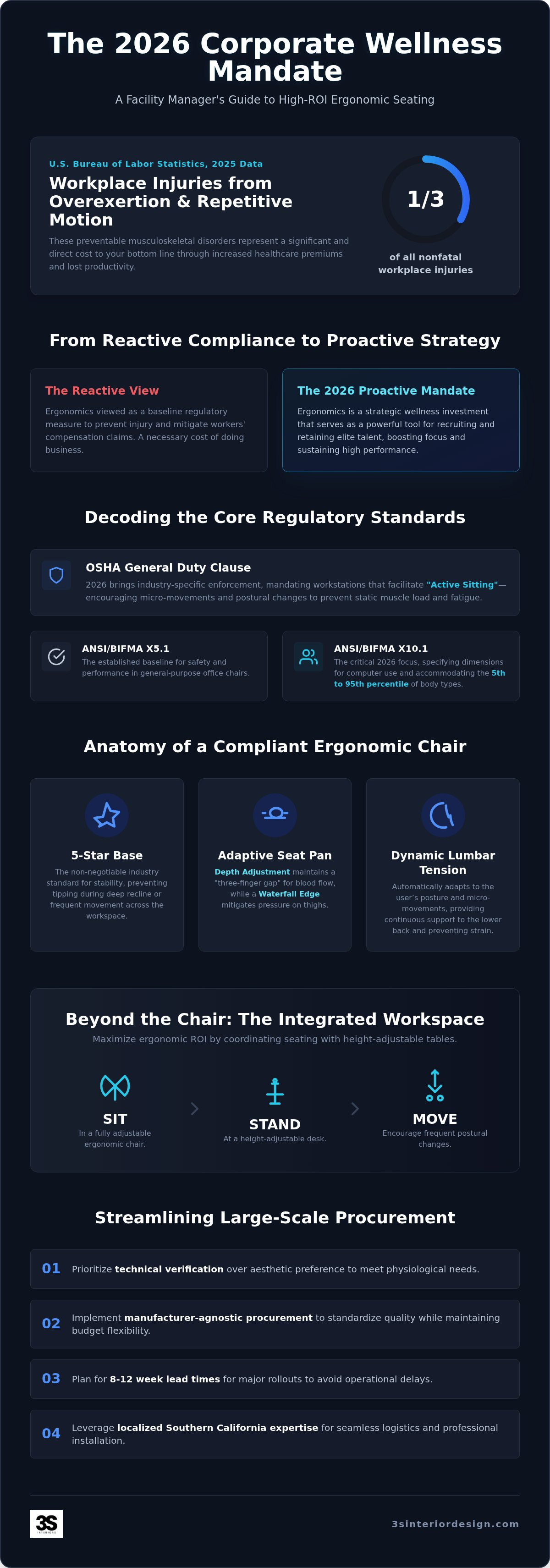
According to 2025 data from the U.S. Bureau of Labor Statistics, overexertion and repetitive motion tasks account for nearly one third of all nonfatal workplace injuries requiring days away from work. For facility managers in Los Angeles and Orange County, these musculoskeletal disorders represent more than just employee discomfort; they're a direct hit to the corporate bottom line through rising healthcare premiums and lost productivity. You likely already understand that high-quality seating is a primary defense against these costs. However, technical jargon like ANSI/BIFMA X10.1-2024 and pneumatic adjustment often makes procurement feel like a high-risk gamble. Understanding the specific ergonomic chair standards for corporate wellness is no longer optional for firms that want to remain competitive in the SoCal market.
We've designed this guide to help you master the technical standards and logistical coordination required to implement a high-ROI seating program. You'll gain a clear understanding of the latest 2026 compliance requirements, including the shift toward industry-specific OSHA enforcement under the General Duty Clause. We'll also provide a streamlined procurement checklist that simplifies the process of outfitting large offices. This article covers everything from technical dimensional requirements to the operational reality of eight-to-twelve-week lead times for major rollouts. By the end, you'll have the strategic framework needed to reduce absenteeism and build a workspace that attracts elite talent.
Table of Contents
Defining Ergonomic Standards in the 2026 Corporate Wellness Landscape
The Technical Checklist: Core Standards for Corporate Seating
Beyond the Chair: Integration with Dynamic Workspace Standards
Procurement Logistics: Managing Large-Scale Corporate Rollouts
The 3S Interior Advantage: Ergonomic Solutions in Southern California
Defining Ergonomic Standards in the 2026 Corporate Wellness Landscape
By 2026, corporate social responsibility (CSR) has expanded to include the physiological health of the workforce as a core metric. Forward-thinking firms in Century City and Irvine no longer view ergonomics as a reactive measure for injury prevention. Instead, it is a proactive wellness strategy designed to sustain high-level performance. Standard office chairs often fail to meet modern benchmarks because they prioritize basic stability over the dynamic physiological needs of a sedentary workforce. Adopting rigorous ergonomic chair standards for corporate wellness ensures that seating supports cognitive focus by minimizing physical distractions such as lower back strain and circulation issues.
The ROI of Ergonomic Compliance
Investing in compliant seating yields measurable financial returns that extend beyond the initial procurement cost. According to 2025 Bureau of Labor Statistics data, musculoskeletal disorders account for nearly one third of nonfatal workplace injuries requiring days away from work. Reducing these claims directly lowers workers' compensation premiums and long-term healthcare expenditures. Beyond cost mitigation, ergonomic seating serves as a critical recruitment tool for competitive Los Angeles tech and finance sectors. Professionals in high-stress hubs prioritize their physical health. Providing a workspace that meets 2026 wellness benchmarks signals that a firm values its human capital, which directly aids in employee retention.
Regulatory Foundations: ANSI/BIFMA and OSHA
Procurement must be grounded in technical certification rather than aesthetic preference. The ANSI/BIFMA X5.1-2017 (R2022) standard remains the baseline for safety and performance in general-purpose office chairs. However, the 2026 landscape emphasizes ANSI/BIFMA X10.1-2024, which specifies dimensional requirements tailored for computer use. These updated standards align with broader ergonomic office chair principles that prioritize user fit across a diverse employee population. They ensure that furniture accommodates the 5th to 95th percentile of body types, which is essential for inclusive corporate environments.
OSHA has also shifted its enforcement strategy for 2026. The agency now utilizes industry-specific enforcement of ergonomic standards under the General Duty Clause. This shift mandates that workstations facilitate "active sitting," a concept that encourages micro-movements and frequent postural changes. Modern ergonomic chair standards for corporate wellness require seating that adapts to these movements automatically. This prevents the static muscle loading that leads to chronic fatigue, ensuring that staff remain alert and productive throughout the business day.
The Technical Checklist: Core Standards for Corporate Seating
Procuring furniture for a high-density office requires a shift from aesthetic preference to technical verification. Professional buyers must prioritize ergonomic chair standards for corporate wellness to ensure every unit meets the physiological needs of a diverse workforce. This checklist focuses on the mechanical specifications that distinguish commercial-grade seating from residential alternatives. High-performance chairs must facilitate "active sitting" through multiple points of adjustment, ensuring the furniture adapts to the user rather than forcing the user to adapt to the chair.
Seat Pan and Base Specifications
Stability and circulation are the primary objectives of seat pan design. A 5-star base is the non-negotiable industry standard for stability; it prevents tipping during deep recline or frequent movement. When evaluating the seat pan, ensure it includes a depth adjustment to maintain a "three-finger gap" between the edge of the seat and the back of the user's knees. This gap is essential for maintaining blood flow to the lower limbs. Additionally, a waterfall edge design, where the front of the seat slopes slightly downward, further mitigates pressure on the thighs. These features align with established workplace safety standards for seating and are critical for long-term comfort.
Backrest and Lumbar Support Requirements
The backrest must provide a pronounced S-curve alignment to support the natural curvature of the spine. While fixed lumbar supports are common in budget models, 2026 wellness benchmarks favor dynamic tension systems. These systems allow the lumbar support to move with the user, maintaining contact even during postural shifts. A synchro-tilt mechanism is equally important; it allows the backrest and seat to tilt at a 2:1 ratio. This ratio keeps the user's feet flat on the floor while they recline, which encourages micro-movements without compromising spinal alignment. Procurement managers should also verify that chairs include tension control to calibrate the recline resistance based on the user's body weight.
Armrests and Peripheral Support
Proper armrest positioning prevents chronic shoulder and neck strain. Look for 4D armrests that adjust for height, width, depth, and pivot. This versatility allows employees to position their elbows directly under their shoulders, keeping the wrists in a neutral position for typing. Soft-touch materials are preferred for the arm caps to relieve pressure points on the ulnar nerve. Choosing the right chair often depends on the specific job function. For more detail on matching furniture to roles, see our ergonomic task chairs vs. executive chairs guide. If you're ready to standardize your office seating, you can consult with our team to review current technical specifications and availability.
Beyond the Chair: Integration with Dynamic Workspace Standards
In 2026, the "Sit-Stand-Move" cycle represents the gold standard for corporate wellness. Even the most sophisticated seating cannot offset the health risks of static behavior. High-ROI programs integrate ergonomic chair standards for corporate wellness into a broader workstation ecosystem. This integration requires precise coordination between seating and height-adjustable tables to ensure a seamless transition between postures. Facility managers must view the chair not as an isolated asset, but as one component of a dynamic workstation that facilitates movement throughout the business day.
When procuring furniture, technical teams must verify that the chair's adjustment range aligns with the desk's minimum and maximum heights. For instance, if a workstation uses a fixed-height surface, chairs may require a higher cylinder range. In these cases, procurement should include industrial-grade footrests to maintain proper floor contact and circulation for shorter users. Understanding how to choose an ergonomic chair involves analyzing these peripheral factors to prevent ergonomic failure at the point of use. If the chair and desk do not work in tandem, the health benefits of both are significantly diminished.
Sit-Stand Desk Implementation
Electric height-adjustable tables dominate large-scale Irvine office rollouts due to their ease of use and consistent performance. Manual cranks often lead to employee non-compliance because of the physical effort required to change positions. During installation, cable management is a critical logistical detail. Loose wires can snag on chair bases or limit the travel range of the desk, creating safety hazards. Strategic placement of these units within open-plan layouts ensures that employees have enough clearance to move between sitting and standing without disrupting neighboring workstations.
Space Planning for Ergonomic Flow
Physical layout directly influences employee posture and movement frequency. A well-designed floor plan encourages staff to migrate between focus areas and collaborative zones. This movement prevents the static muscle loading that occurs when an employee remains in one position for the entire day. Integrating ergonomic lounge seating in common areas provides a secondary postural option for casual meetings or deep work. We offer comprehensive office space planning services to help firms optimize their workstation configurations for maximum ergonomic flow and operational efficiency. By treating the office as a dynamic system, you ensure that your investment in high-quality seating pays dividends through a healthier, more engaged workforce.
Procurement Logistics: Managing Large-Scale Corporate Rollouts
Large-scale furniture acquisition requires a methodical approach to balance budget constraints with ergonomic chair standards for corporate wellness. Facility managers often face the challenge of outfitting diverse departments while maintaining a cohesive aesthetic and functional baseline. Successful procurement involves manufacturer-agnostic planning. By selecting the best-in-class seating from various verified manufacturers, you avoid the limitations of a single product line and maximize budget efficiency. This diversity allows for a tiered strategy where chair features are matched specifically to job functions, from high-performance task seating for data analysts to refined solutions for executive suites in Century City.
Budgeting for Quality and Scale
Strategic budgeting prioritizes the Total Cost of Ownership (TCO) over the initial purchase price. Opting for budget-grade chairs often results in shorter replacement cycles and increased injury risk, which negates any upfront savings. High-quality seating typically carries an eight-to-twelve-week lead time for custom corporate rollouts, making early planning essential. Consider these factors when scaling your seating program:
Functional Tiering: Assign chairs with specific adjustment ranges, such as 4D armrests, to roles with the highest sedentary time.
Volume Procurement: Leverage scale to secure better terms for standardized workstations across multiple regional offices.
Replacement Reserves: Factor in a 5% to 10% buffer for rapid headcount growth or localized repairs to ensure operational continuity.
Professional Installation and Lifecycle Management
Executing a rollout in high-traffic districts like Santa Monica or Beverly Hills requires precise logistical coordination. Professional installation is mandatory for maintaining manufacturer warranty compliance and ensuring every unit is assembled to technical specifications. Beyond assembly, project managers coordinate the transition from delivery to final placement, minimizing disruption to active business operations. Post-installation, we recommend conducting brief training sessions to teach employees how to utilize their specific ergonomic features. Without this step, even the most advanced chair remains an underutilized asset. Effective asset management also includes tracking maintenance schedules and planning for modular office reconfigurations as your firm expands.
Managing the complexities of a large-scale furniture deployment requires a seasoned strategic partner. You can contact our project management team to coordinate your next corporate seating rollout with precision and reliability.
The 3S Interior Advantage: Ergonomic Solutions in Southern California
Southern California’s corporate landscape demands more than just aesthetic office furniture; it requires high-performance environments built on technical precision. 3S Interior Design serves as a methodical expert for firms operating in the Los Angeles, Beverly Hills, and Irvine business districts. We specialize in navigating the complex logistical requirements and ergonomic chair standards for corporate wellness, providing a bridge between technical compliance and operational reality. Our approach isn't about one-off sales. It's about establishing long-term professional relationships through a comprehensive, turnkey service model that prioritizes your project's functional success and long-term stability.
End-to-End Service for SoCal Businesses
We begin every partnership with an on-site consultation to identify specific workstation deficiencies within your current office layout. Many facility managers struggle with mismatched equipment that fails to meet 2026 wellness benchmarks. Our team provides a curated selection of ergonomic office seating that is strictly ANSI/BIFMA compliant, ensuring every chair meets rigorous safety and durability tests. We manage the entire lifecycle of the procurement process, from initial space planning and layout design to final professional installation. This end-to-end coordination ensures that your office remains operational during rollouts, as we handle the heavy lifting of regional logistics, traffic coordination, and delivery scheduling.
Our project management team understands the unique challenges of outfitting large offices in high-traffic hubs. We provide a structured hierarchy of service that moves from initial assessment to final execution without the common delays associated with generalist providers. By choosing a partner with localized expertise in Los Angeles and Orange County, you gain access to a streamlined supply chain and professional installers who understand the specific requirements of commercial office buildings in the region.
Your Strategic Wellness Partner
Selecting the right seating program involves more than picking a model from a catalog. It requires a strategic partner who understands how to mitigate professional risk through expert product selection and technical verification. Our focus on logistical reliability ensures that high-volume orders for regional headquarters are delivered and installed according to your specific timeline. By standardizing your office with verified ergonomic chair standards for corporate wellness, you protect your firm from the hidden costs of absenteeism and repetitive motion injuries. We provide the technical expertise needed to translate abstract wellness goals into a physical workspace that supports your human capital.
If you're ready to upgrade your corporate environment with professional-grade seating and workstations, contact 3S Interior Design for a consultation on your next workspace project. We'll help you master the procurement logistics and technical standards required for a successful, high-ROI seating program.
Strategic Seating for Long-Term Operational Success
Adhering to ergonomic chair standards for corporate wellness is no longer just a checkbox for safety compliance; it's a strategic investment in your firm's human capital. By prioritizing ANSI/BIFMA-certified seating and integrating it into a dynamic workspace, you reduce the physical fatigue that leads to absenteeism and lost productivity. Success in large-scale procurement depends on more than just selecting a high-quality model. It requires precise coordination of technical specifications, manufacturer-agnostic planning, and expert installation to ensure every workstation performs as intended.
3S Interior Design provides the methodical expertise needed to manage these complexities for Southern California businesses. As commercial furniture experts, we offer full turnkey project management, including comprehensive space planning and professional installation services. We focus on the logistical details that ensure your project stays on schedule and within technical requirements. You don't have to manage these professional risks alone. Schedule a Professional Workspace Consultation with 3S Interior Design to secure a compliant, high-ROI environment for your team. We look forward to helping you build a more resilient and productive office.
Frequently Asked Questions
What are the most important ANSI/BIFMA standards for corporate office chairs?
The primary ergonomic chair standards for corporate wellness include ANSI/BIFMA X5.1-2017 (R2022) and the newer X10.1-2024. While X5.1 ensures general structural safety and performance, X10.1-2024 focuses on the specific dimensions required for intensive computer work. These standards ensure that seating accommodates the 5th to 95th percentile of the workforce. Procurement teams should verify these certifications to ensure their furniture investment meets the highest commercial benchmarks for performance and durability.
How do ergonomic chairs contribute to a corporate wellness program?
Ergonomic chairs serve as a proactive health tool by maintaining spinal alignment and reducing static muscle loading throughout the business day. By supporting the natural S-curve of the spine and facilitating micro-movements through synchro-tilt mechanisms, these chairs minimize physical fatigue. This results in higher cognitive focus and reduced employee absenteeism. In competitive markets like Orange County, providing high-standard seating also acts as a recruitment asset, demonstrating a firm's commitment to long-term employee health.
Can ergonomic seating reduce my company’s workers compensation claims?
Implementing high-quality seating can significantly reduce musculoskeletal disorders (MSDs), which represent nearly one third of all nonfatal workplace injuries. By following ergonomic chair standards for corporate wellness, you mitigate the repetitive strain that leads to long-term claims. OSHA’s 2026 enforcement strategy specifically targets ergonomic hazards under the General Duty Clause. Investing in compliant furniture helps protect your firm from these regulatory risks while lowering the frequency of expensive workers' compensation filings.
How often should a corporate office replace its ergonomic seating?
Commercial-grade ergonomic seating typically requires replacement every seven to ten years. This timeline depends on the manufacturer's warranty and the mechanical integrity of the pneumatic cylinders and adjustment levers. In high-use environments, such as call centers or shared workstations, components may wear faster. Facility managers should conduct annual audits to check for structural stability and hydraulic failure. Replacing seating proactively prevents the ergonomic decline that occurs when support mechanisms lose their tension.
What is the difference between a task chair and an ergonomic wellness chair?
A standard task chair generally provides basic height and swivel functions for short-term use. In contrast, an ergonomic wellness chair features 4D armrests, dynamic lumbar tension, and adjustable seat pans designed for full-day shifts. These advanced models prioritize "active sitting," allowing the chair to move with the user's postural shifts. For corporate environments, standardizing on wellness-focused chairs ensures that every employee has the support necessary to prevent chronic strain during intensive computer work.
Is a 5-star base really necessary for office chair stability?
A 5-star base is the mandatory industry standard for stability and safety. Chairs with four legs or fewer are prone to tipping when a user reclines or reaches across their desk. The five-point configuration provides a stable center of gravity and ensures that the chair remains balanced during frequent movement. For corporate rollouts, only chairs with a 5-star base meet the structural performance requirements established by BIFMA, ensuring a safe and reliable environment for all staff.
How do I choose ergonomic chairs for a hybrid workforce?
When selecting chairs for a hybrid workforce, prioritize high adjustability ranges to accommodate multiple users at shared "hot desks." Since different employees will use the same workstation throughout the week, the chair must feature intuitive controls for seat height, depth, and lumbar tension. Standardizing on one or two highly adjustable models ensures that every team member can quickly calibrate their seating for optimal support, regardless of their physical stature or individual work habits.
Should I provide footrests alongside ergonomic chairs?
Footrests are necessary only when the chair's height must be raised to align with a fixed desk, preventing the user's feet from resting flat on the floor. Proper ergonomic posture requires feet to be fully supported to maintain circulation and reduce pressure on the lower back. If your office utilizes height-adjustable tables, footrests are usually unnecessary as the desk can be lowered. However, for fixed-height workstations, providing footrests ensures that shorter employees can maintain a neutral posture.


Comments