


Modern Office Furnishings: A Strategic Guide to 2026 Workspace Trends
- amber7624
- Aug 8
- 11 min read
Your office furniture isn't just a line item for depreciation; it's a strategic asset that directly influences your bottom line. Facility managers in high-rent markets like Santa Monica and Irvine often struggle to balance ergonomic compliance with limited floor plans. Managing a fragmented list of vendors for procurement and installation creates unnecessary risk and logistical delays. It's a common frustration to see a professional aesthetic compromised by poor coordination or outdated seating solutions.
We understand that a workspace must function as a well-oiled machine. This guide shows you how modern office furnishings drive employee productivity and operational efficiency through methodical design and professional procurement. By viewing your environment through a strategic lens, you can improve employee retention and secure a cohesive, professional aesthetic. We will preview the critical 2026 workspace trends, including the latest ergonomic standards and modular systems. You'll learn how a streamlined approach to end-to-end delivery ensures your project stays on schedule and meets every technical specification.
Table of Contents
Defining Modern Office Furnishings in the 2026 Workspace
Modern office furnishings are high-performance commercial assets specifically engineered for high-traffic professional environments. They aren't equivalent to retail or residential furniture. In 2026, the industry has transitioned away from static, isolated desks toward dynamic, technology-integrated workstations that support a mobile and tech-dependent workforce. These systems are designed to withstand the rigors of 40-plus hour work weeks while maintaining their structural integrity and aesthetic appeal. Choosing the right furniture is a long-term investment in your company's operational stability.
Professional standards are the benchmark for any strategic procurement plan. Adhering to BIFMA G8.1-2026 guidelines ensures that surfaces and materials are resistant to intensive cleaning protocols, a requirement that became standard for commercial settings in early 2026. Beyond durability, your furniture serves as a physical manifestation of corporate identity. A methodical selection process ensures that every piece, from the reception desk to the executive suite, reinforces your brand's reputation for stability and professionalism. It's a clear signal to clients and employees that your organization values precision and quality.
The Core Components of a Modern Workspace
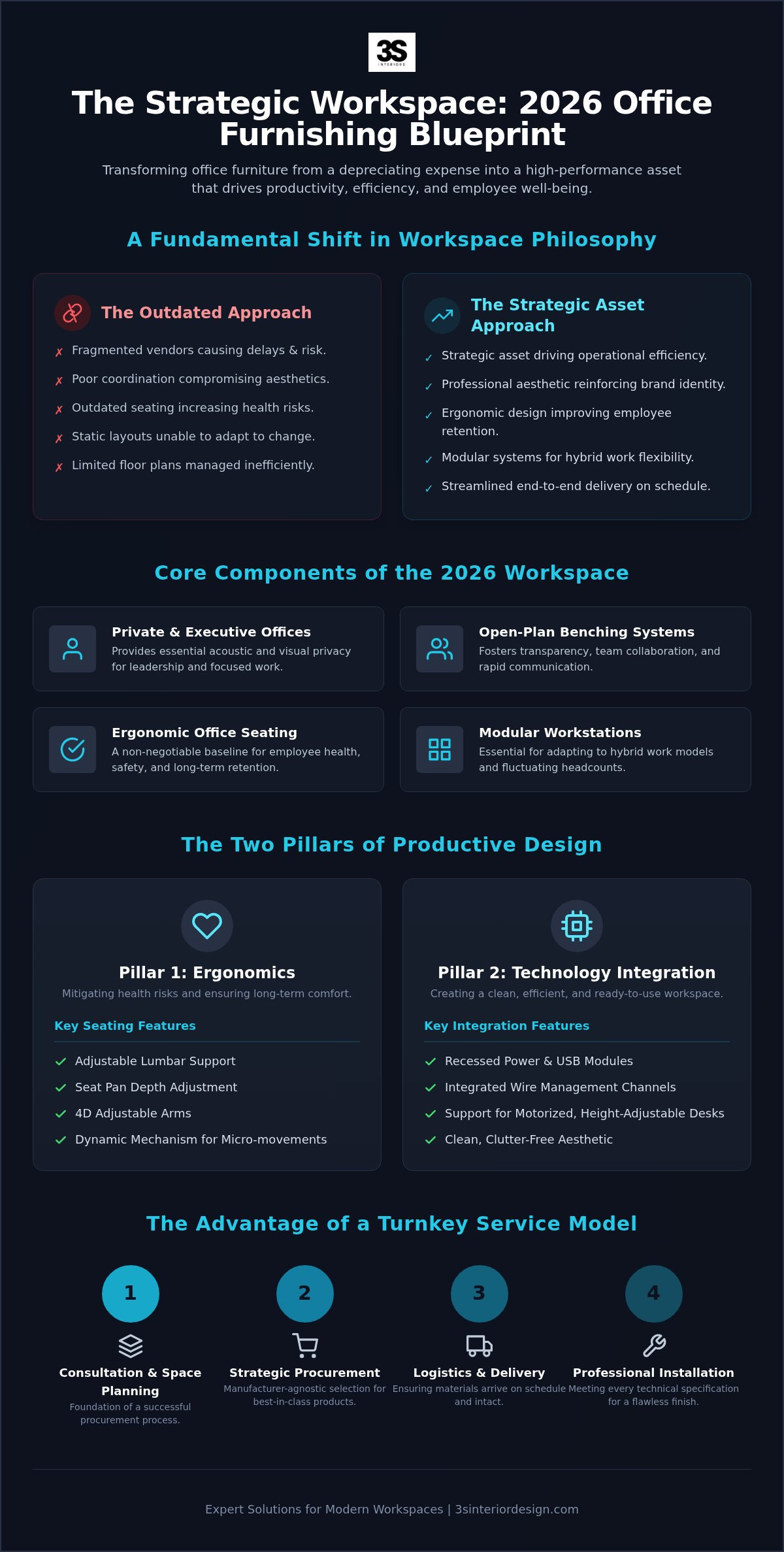
A comprehensive workspace strategy utilizes a mix of private and collaborative zones. Private office desks and executive casegoods provide the necessary acoustic and visual privacy for leadership roles. Conversely, open-plan benching systems foster transparency and facilitate rapid communication among teams. The evolution of these layouts is rooted in the history of the modern cubicle. It transitioned from rigid enclosures to the flexible, modular systems we see today. Ergonomic office seating remains a non-negotiable baseline for employee health and safety, directly impacting long-term retention and reducing workplace injury risks.
Aesthetics vs. Functional Durability
Selecting materials for a commercial environment requires a focus on functional durability. Modern office furnishings in 2026 emphasize clean, architectural lines that conceal complex integrated power and data solutions. This integration eliminates the clutter of exposed wiring. It ensures that workstations are ready for immediate use. We recommend a manufacturer-agnostic approach to planning. This strategy allows facility managers to select the best-performing products across different brands. You get a cohesive style without being restricted to a single catalog. This flexibility is vital for businesses in Los Angeles and Irvine that need to optimize limited floor plans while maintaining a high-end, professional look.
Ergonomics and Technology: The Pillars of Productive Design
Strategic investment in modern office furnishings is a primary method for mitigating professional health risks. High-performance ergonomic seating and height-adjustable surfaces are no longer optional perks; they're essential tools for maintaining a healthy, efficient workforce. For facility managers, the goal is to align furniture specifications with the physical needs of a diverse team. Task chairs must provide extensive adjustability to support eight-hour shifts, while conference room seating should prioritize ease of movement and intuitive controls for shorter, high-impact meetings.
Technology integration is equally critical. Modern surfaces now feature recessed power modules and integrated wire management channels to keep workstations organized. This prevents the logistical hazard of "cable creep" and ensures that every desk is ready for immediate deployment. When planning these layouts, it's vital to consider the electrical infrastructure. Motorized desk systems increase the power load on your floor plan. Proper space planning and layout design ensures your office can support these advanced systems without overloading existing circuits.
Selecting Ergonomic Seating for Diverse Teams
Standardizing your seating inventory is a pragmatic approach to facility maintenance. When you select a primary task chair model, you simplify your spare parts inventory and streamline the training required for employees to adjust their equipment. Look for chairs that feature adjustable lumbar support, seat pan depth, and 4D adjustable arms. These features allow a single chair model to accommodate individuals of varying heights and weights. Dynamic seating refers to a mechanism that promotes constant micro-movements to correct posture and reduce static muscle load. By providing this level of support, you reduce the risk of long-term injuries and improve overall employee retention.
Height-Adjustable Solutions for Active Workspaces
The global standing desk market is projected to reach $9.1 billion in 2026. This growth is driven by the proven benefits of electric sit/stand desks for employee energy levels and focus. When evaluating these systems, compare single-stage and dual-stage lift mechanisms. Dual-stage columns offer a wider range of height adjustment and greater stability at maximum extension, which is critical for taller employees. You must also account for the BIFMA G8.1-2026 standard for surface durability. This ensures your investment resists the wear of motorized movement and frequent sanitization. Implementing these systems requires a methodical approach to procurement to ensure all motorized components meet local electrical codes and performance standards.
Modular Workstations and Hybrid-Ready Benching Systems
Southern California businesses face volatile market conditions and high real estate costs. Modularity is a strategic requirement, not just a design preference. It allows for rapid reconfiguration as headcounts fluctuate. Investing in modular modern office furnishings ensures that your floor plan remains an adaptable asset rather than a static expense. This long-term mindset is essential for facility managers who must justify furniture expenditures against future growth projections. A well-planned modular system reduces the need for costly renovations when your team structure changes.
Open Plan Benching vs. Traditional Cubicles
The shift toward open-plan benching systems is driven by floor-space efficiency. Traditional cubicles often limit density to a lower ratio of employees per square foot compared to streamlined benching. However, this transition requires careful planning to maintain productivity. You must balance the lack of physical walls with acoustic screens and dividers to manage noise levels. Integrated storage and filing systems are essential here; they prevent the visual clutter that often plagues open environments. While cubicles offer superior acoustic control, benching systems provide a significant ROI by allowing more staff to occupy the same footprint without sacrificing professional standards. This transition is most successful when you incorporate high-quality acoustic screens that mitigate the noise of open-plan collaboration.
Designing for Flex-Space and Touchdown Areas
The rise of hybrid work models has changed the function of the lobby and reception area. These spaces now serve as touchdown zones for transient workers who don't require a permanent desk. Equipping these areas with specialized lobby furniture and breakout seating, such as the iconic stools from TH Brown, creates informal meeting points that alleviate pressure on primary conference rooms. It's a pragmatic solution for offices that host rotating teams or frequent external consultants. It ensures that every visitor has a functional place to work without disrupting the core office zones.
Mobile storage units are a critical component of this flex-space strategy. They allow employees to move their essential materials between collaborative zones and private focus areas. By integrating these modern office furnishings into your layout, you support a fluid workforce while maintaining a clean, professional aesthetic. This approach ensures that every square foot of your Santa Monica or Irvine office is utilized effectively, regardless of how many employees are physically present on a given day. Professional installation services are required to ensure these modular components are anchored correctly and integrated with existing power systems to maintain safety compliance.
Procurement and Logistics: The Professional Installation Process
Commercial furniture procurement is a multi-phase logistical challenge that demands a methodical approach. Lead times for custom or high-volume orders typically average 8 to 12 weeks, meaning planning must begin months before a move-in date. Facility managers must also account for logistical overhead; shipping and professional installation often add 10% to 20% to the total project budget. Navigating delivery in high-density Southern California corridors like Century City or Beverly Hills introduces additional variables. These high-traffic areas often have strict loading dock schedules and specific insurance requirements for high-rise buildings. A fragmented procurement strategy often leads to delays that disrupt business operations and increase costs.
Strategic Space Planning and Layout Design
Managing the Installation Timeline
A successful setup depends on the synchronization of multiple trades. Our project management team serves as a single point of contact to coordinate with IT and electrical contractors. This ensures that power drops and data ports align perfectly with the integrated wire management systems of your new workstations. Professional installers are required for modular cubicle systems because they possess the specialized tools and technical knowledge needed to ensure structural stability and correct electrical connectivity. Using certified professionals is also a mandatory requirement for maintaining manufacturer warranties. If an unqualified team handles the assembly, you risk voiding the protection on your long-term assets. This specialized expertise is what separates a professional workspace from a temporary setup.
To ensure your project meets these rigorous standards, it's essential to partner with a provider that offers end-to-end management. You can secure the functional success of your workspace by utilizing our specialized furniture installation services.
The 3S Advantage: Turnkey Modern Furnishing Solutions
3S Interior Design functions as a methodical expert in the procurement and deployment of modern office furnishings. We manage the entire furniture lifecycle for your business. This process includes everything from the initial space assessment to the final project handover. For C-suite executives, this turnkey model reduces professional risk by consolidating accountability into a single strategic partner. You don't have to manage a fragmented list of vendors or coordinate conflicting delivery schedules. We handle the complex logistical details that often overwhelm internal facility teams. Our focus remains on delivering operational stability through high-quality commercial assets.
A curated selection process is central to our service model. We don't just provide a catalog; we provide a strategy. We evaluate your specific style requirements alongside your budgetary constraints to select the best-performing products across multiple manufacturers. This manufacturer-agnostic approach ensures you receive the highest ROI for your investment. Every piece of furniture we specify meets professional standards for durability and ergonomic compliance. It's a pragmatic way to ensure your workspace reflects your corporate identity while remaining functionally superior.
Comprehensive Service from Consultation to Final Walkthrough
Our service model follows a predictable and highly organized timeline that mirrors your project's lifecycle. We start with an initial consultation to establish your functional requirements and technical specifications. Once the layout design is finalized, we take full control of the procurement phase. This step is critical for ensuring that every component of your order arrives on schedule and matches the approved CAD drawings. The process concludes with professional installation and comprehensive site cleanup. We deliver a move-in ready office that is fully compliant with all safety standards. This end-to-end management ensures total continuity across every phase of the project.
Local Southern California Expertise
Local knowledge is a primary driver of project efficiency. We understand the specific logistical constraints of Southern California office parks and high-rise developments. Whether you're furnishing a high-growth tech hub in Santa Monica or a creative agency in Burbank, we navigate the regional requirements for insurance and loading dock access. Our teams are deeply familiar with the building codes in Los Angeles and Irvine. This expertise allows us to complete projects faster and with fewer disruptions to your daily operations. We provide the localized support required to manage the unique challenges of the Southern California market.
To secure the functional and aesthetic success of your next workspace project, Contact 3S Interior Design for a professional consultation. We provide the specialized guidance needed to transform your environment into a strategic business asset.
Securing the Future of Your Corporate Environment
Selecting modern office furnishings is a strategic decision that impacts your organization's operational efficiency for years. We've analyzed how ergonomic standards and modular systems provide the flexibility needed for the 2026 workspace. It's clear that a successful project depends on precise execution, from initial CAD layouts to the final professional installation. By prioritizing commercial-grade durability and manufacturer-agnostic procurement, you mitigate long-term professional risks and ensure a cohesive aesthetic.
3S Interior Design provides the specialized expertise required to manage these complex logistical timelines. We offer expert space planning and layout design to optimize every square foot of your Southern California office. Our local installation teams ensure that your project meets all building codes and maintains full warranty support. Transitioning to a high-performance environment is a methodical process that requires a reliable strategic partner. We're ready to manage the details so you can focus on your core business objectives.
Ready to optimize your workspace? Request a Turnkey Workspace Consultation today. We look forward to delivering a workspace that supports your long-term professional success.
Frequently Asked Questions
What are the current trends in modern office furnishings for 2026?
Leading trends in 2026 emphasize the integration of technology and adherence to the BIFMA G8.1-2026 standard for surface durability. Modern office furnishings now prioritize modularity to support hybrid work models and reconfigurable floor plans. You'll also see a rise in resimercial designs that combine commercial-grade performance with softer aesthetics. These trends focus on long-term operational flexibility and employee wellness through improved material specifications and integrated power solutions.
How do I choose between open-plan benching and private workstations?
Choosing between these systems requires an analysis of your team's workflow and your real estate costs. Open-plan benching systems maximize employee density and facilitate rapid collaboration, which is ideal for creative or sales teams. Private workstations are necessary for roles requiring high acoustic privacy and focused leadership. We recommend a hybrid approach that utilizes acoustic screens to balance these conflicting needs while maintaining a professional aesthetic across your floor plan.
What is the difference between commercial-grade and residential office furniture?
Commercial-grade furniture is engineered to withstand 40-plus hours of weekly use and meets rigorous BIFMA/ANSI safety standards. Residential furniture lacks the structural reinforcement and material durability required for high-traffic office environments. Investing in commercial assets ensures you have access to comprehensive warranty support and replacement parts. This distinction is critical for facility managers who must mitigate professional risk and ensure long-term structural integrity in their workspace.
Does 3S Interior Design provide installation in Beverly Hills and Irvine?
Yes, we provide comprehensive furniture installation services across all major Southern California business hubs, including Beverly Hills and Irvine. Our teams understand the specific logistical requirements of high-density corridors, such as loading dock schedules and high-rise insurance mandates. We leverage this local expertise to ensure your project remains on schedule despite the complex traffic and building regulations common in the Los Angeles and Orange County areas.
Why is space planning important before buying modern office furniture?
Space planning is the foundation of a successful procurement process because it prevents costly ordering errors and ensures ADA compliance. It allows you to visualize modern office furnishings within your specific floor plan using CAD and 3D rendering. This technical assessment optimizes traffic flow and ensures that your electrical infrastructure can support motorized height-adjustable tables. Without a professional layout design, you risk purchasing furniture that doesn't fit your physical constraints.
How long does the typical commercial furniture installation take?
The typical commercial furniture installation can range from a single day for small offices to several weeks for multi-floor corporate headquarters. While the physical assembly is efficient, you must account for the 8 to 12 week lead time required for furniture procurement. We coordinate closely with IT and electrical contractors to ensure a seamless setup. Our project managers provide a single point of contact to keep your installation timeline predictable and organized.
Can modern furnishings help with office acoustics and noise reduction?
Modern furnishings are specifically designed to address acoustic challenges through the use of specialized materials and modular dividers. Acoustic screens and benching dividers help absorb ambient noise and reduce sound travel in open-plan environments. These solutions allow you to maintain an efficient, high-density floor plan without sacrificing the quiet required for focused work. Integrating these acoustic components is a pragmatic way to improve employee productivity and reduce workplace distractions.
What ergonomic features should I look for in an executive task chair?
An executive task chair must offer a high level of adjustability to support a diverse workforce. Look for features such as adjustable lumbar support, seat pan depth, and 4D adjustable arms that move in multiple directions. Dynamic seating mechanisms are also essential for promoting posture correction throughout the day. Standardizing these ergonomic features across your seating inventory simplifies facility maintenance while ensuring that every employee has the support needed for long-term health.


Comments