


Office Filing Cabinets in Los Angeles: A 2026 Guide to Commercial Storage Systems
Updated: Sep 11
In the high-pressure environment of Southern California business, an inefficient storage system is more than an eyesore; it's a drain on your bottom line. With the 2025 California Building Standards Code now in full effect as of January 1, 2026, the stakes for selecting office filing cabinets Los Angeles professionals can rely on have never been higher. You likely recognize the frustration of seeing valuable floor space wasted by bulky units that fail to match your existing office casegoods. It's a common logistical challenge that complicates both daily operations and long-term facility planning.
This guide provides a methodical framework for selecting and integrating professional-grade filing systems that prioritize both spatial efficiency and legal safety. You'll discover how to navigate the complexities of 2026 seismic anchoring regulations while maintaining a cohesive aesthetic across your workspace. We'll outline the specific technical requirements for modern storage, from high-density lateral files to integrated pedestals, ensuring your office remains organized, compliant, and ready for growth. By focusing on precision and professional standards, you can transform your storage from a cluttered necessity into a strategic asset.
Table of Contents
The Strategic Role of Office Filing Cabinets in Modern Workspaces
Understanding Commercial Filing Systems: Categories and Specifications
Lateral vs. Vertical Filing: A Comparative Performance Analysis
Planning Your Storage Layout: Safety and Compliance Standards
Professional Procurement: Sourcing Filing Systems in Los Angeles
The Strategic Role of Office Filing Cabinets in Modern Workspaces
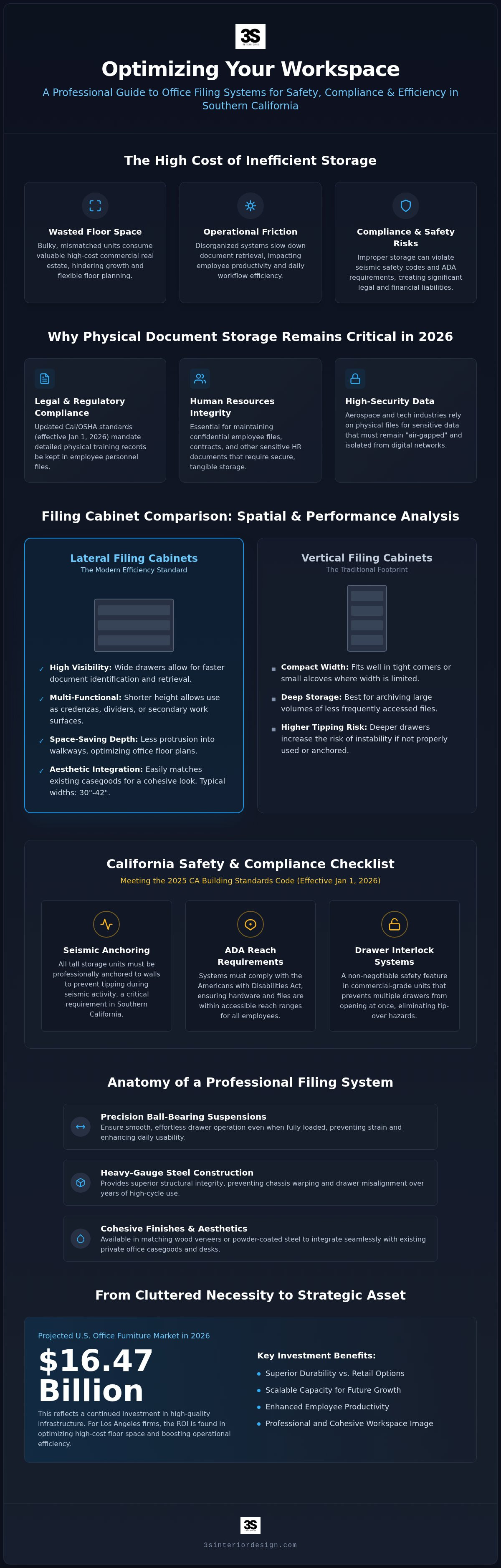
Physical document management remains a critical operational pillar in 2026. While digital transformation is widespread, specific regulatory mandates require tangible records. For instance, the updated Cal/OSHA standards effective January 1, 2026, require California employers to maintain detailed education and training records within employee personnel files. These records must include the provider name, duration, and core competencies. High-security sectors in the Los Angeles aerospace and technology industries also rely on physical filing for sensitive data that must remain air-gapped from digital networks. Professional filing cabinet basics dictate that these units are not just containers but essential tools for maintaining legal and operational compliance.
Effective storage planning directly influences office flow. When you integrate storage with your private office desks and casegoods, you eliminate the logistical friction of disorganized workspaces. Methodical organization reduces the time employees spend searching for documents, which supports overall productivity. By selecting office filing cabinets Los Angeles firms can coordinate with their existing furniture, the transition from a cluttered floor plan to a streamlined environment becomes a manageable project phase rather than an architectural afterthought.
Beyond Storage: Filing as an Interior Design Element
Modern commercial storage serves a dual purpose. High-end lateral files can function as workspace dividers or low-profile credenzas within executive suites. Matching wood veneers or powder-coated steel finishes with your primary casegoods ensures aesthetic consistency. This approach projects an image of professional stability to clients and partners. Using storage as a structural element helps define zones in open-plan offices without the need for permanent walls. It's a pragmatic way to maintain a cohesive look while solving functional needs.
The Business Case for High-Density Commercial Systems
The U.S. office furniture market is projected to reach USD 16.47 billion in 2026, reflecting a continued investment in high-quality infrastructure. For Los Angeles firms, the ROI of professional storage is found in floor space optimization. Commercial-grade steel systems offer superior durability compared to retail-level options, handling the weight of high-density filing without drawer misalignment. Investing in scalable systems allows your facility to expand its capacity without increasing its physical footprint, which is a critical consideration given the high cost of Southern California commercial real estate.
Understanding Commercial Filing Systems: Categories and Specifications
Commercial filing systems are engineered for high-cycle use in rigorous business environments. Unlike consumer-grade units, these systems feature precision ball-bearing suspensions and heavy-gauge steel construction. When sourcing office filing cabinets Los Angeles facility managers must distinguish between basic storage and professional-grade document management frameworks. These frameworks prioritize structural integrity through several key specifications:
Precision Suspensions: Heavy-duty ball-bearing slides ensure smooth drawer operation even under full weight capacity.
Interlock Systems: Crucial safety mechanisms prevent multiple drawers from opening simultaneously, which eliminates the risk of unit tip-overs.
Gauge Thickness: High-grade steel prevents chassis warping and ensures long-term drawer alignment.
Lateral Filing Cabinets: The Modern Standard
Lateral units have become the standard for office filing cabinets Los Angeles firms deploy in high-traffic zones. Their width-based design, typically ranging from 30 to 42 inches, provides high visibility and easier access to records compared to deeper vertical alternatives. Employees can view more file tabs at a single glance, which significantly speeds up document retrieval times. Because they are shorter and wider, these cabinets often serve a dual purpose. They can act as secondary work surfaces or credenzas in open-plan areas. This multi-functional approach is particularly effective in Los Angeles suites where maximizing every square foot is an operational priority.
Vertical and Pedestal Solutions
Vertical cabinets remain relevant for offices with limited wall space. They maximize verticality by utilizing a deeper, narrower footprint. While they offer high storage volume, they require significant "pull-out" space for drawer extension, which can block busy walkways. For agile workstations, mobile pedestals are the standard choice. You can easily integrate these compact units with commercial workstations and cubicles to provide employees with personal storage that doesn't compromise their primary workspace. These pedestals often fit directly under height-adjustable tables, maintaining a clean and organized aesthetic.
Successful implementation requires a strategic balance between these different configurations. If you're currently assessing your storage requirements, our team can help you coordinate a complete furniture solution that aligns your storage capacity with your specific architectural constraints.
Specialty Storage and Security
Certain industries require specialty specifications to meet risk management goals. Fire-resistant cabinets are essential for protecting original contracts or historical deeds. These units are tested to withstand extreme temperatures for specific durations, maintaining internal temperatures below the char point of paper. High-security locking mechanisms, including digital keypads or dual-custody locks, provide an extra layer of protection for sensitive HR or financial data. Professional locksmiths such as Two Keys Mobile can provide guidance on the most secure hardware options for these commercial systems. These technical specifications ensure your organization meets internal security standards while complying with external data protection requirements.
Lateral vs. Vertical Filing: A Comparative Performance Analysis
Selecting the right configuration for office filing cabinets Los Angeles facilities managers procure requires a detailed analysis of available square footage and document volume. The choice between vertical and lateral systems isn't merely aesthetic; it's a logistical decision that impacts the total cost of occupancy. While vertical units are often perceived as space-savers due to their narrow width, they require significant depth for drawer extension. In contrast, lateral units utilize a wider but shallower footprint that often aligns more effectively with modern architectural layouts in Southern California business districts.
Space Efficiency Metrics
In premium real estate markets like Century City and Santa Monica, maximizing linear filing inches per square foot is an operational necessity. Vertical cabinets typically measure 15 to 18 inches wide but reach up to 28 inches in depth. When you account for the additional 28 inches required for full drawer clearance, a single unit can claim over four feet of aisle depth. This often creates bottlenecks in narrow hallways or smaller private offices. Lateral units, while measuring up to 42 inches wide, only require 18 inches of depth. This shallower profile allows them to sit flush against corridor walls without obstructing traffic flow when drawers are closed. For high-volume document retention, lateral systems generally offer a lower cost-per-linear-inch by providing greater capacity within a more predictable footprint.
Mechanical and Safety Features
The mechanical integrity of a filing system determines its long-term reliability and workplace safety. High-performance office filing cabinets Los Angeles professionals trust must feature precision ball-bearing suspensions. Unlike cheaper nylon rollers that degrade under stress, ball-bearing slides ensure smooth operation even when drawers reach their maximum weight capacity. This precision is vital for employees who access records frequently throughout the workday. Safety standards also dictate the inclusion of specific internal mechanisms:
Anti-Tip Interlocks: These systems prevent more than one drawer from being opened at a time, maintaining the unit's center of gravity and preventing hazardous tip-over accidents.
Heavy-Gauge Steel Chassis: A reinforced frame prevents the cabinet from "racking" or twisting, which ensures drawers stay aligned and locks remain functional.
Centralized Locking: High-security locks are mandatory for HIPAA compliance in medical offices and for protecting sensitive client data in legal firms.
Durability is a primary differentiator between commercial and retail storage. Professional-grade cabinets are engineered for 20-plus years of service, handling the daily rigors of a busy corporate environment. By prioritizing mechanical specifications over initial price points, organizations reduce the frequency of furniture replacement and mitigate the risk of workplace injuries. This pragmatic approach to procurement ensures that your storage infrastructure supports your operational goals without becoming a recurring maintenance liability.
Planning Your Storage Layout: Safety and Compliance Standards
Integrating office filing cabinets Los Angeles businesses use requires strict adherence to the 2026 California Building Standards Code. Compliance isn't optional; it's a foundational requirement for operational safety and risk mitigation. Poorly planned layouts create physical hazards and significant legal liabilities during building inspections. Professional space planning ensures that your storage infrastructure supports your workflow without compromising the safety of your personnel.
Seismic Considerations for Southern California
Los Angeles is a high-seismic zone, making structural stability a primary concern. Title 24 of the California Building Standards Code, which became effective on January 1, 2026, mandates that tall storage units must be properly secured to the building structure. Professional anchoring prevents heavy units from tipping during a seismic event, protecting both your employees and your property. DIY anchoring often fails to meet the specific pull-out strength requirements defined by local structural engineers. We recommend weight distribution strategies that place heavier archival items in bottom drawers to lower the center of gravity across all multi-unit configurations.
Ergonomic and Accessible Design
ADA compliance ensures your workspace is inclusive and legally sound. When arranging office filing cabinets Los Angeles regulations require that aisle widths accommodate wheelchair navigation, typically necessitating a minimum of 36 inches of clear floor space. Reach ranges are equally critical for accessibility. For a side reach, the unobstructed high reach shouldn't exceed 48 inches, and the low reach should be no less than 15 inches from the floor. Pull-style handles are generally superior to recessed grips for universal design, as they allow for easier operation without the need for tight grasping or twisting.
Fire code regulations also dictate the strategic placement of your storage systems. You must maintain at least 18 inches of clearance between the top of any cabinet and the ceiling sprinklers to ensure proper water distribution during an emergency. Additionally, cabinets can't obstruct designated egress paths or fire exit signage. These technical details are best managed through professional office space planning services. Our team ensures every unit is positioned to maximize capacity while strictly adhering to the 2026 County of Los Angeles Building Code.
To ensure your facility meets all current safety and accessibility mandates, contact our project management team for a comprehensive layout assessment.
Professional Procurement: Sourcing Filing Systems in Los Angeles
Retail procurement often fails to address the logistical complexities inherent in high-rise commercial environments. In major business districts like Downtown Los Angeles or Century City, furniture delivery requires meticulous coordination with building management regarding loading dock access and freight elevator scheduling. Professional procurement ensures that your office filing cabinets Los Angeles project proceeds without site access delays. By shifting from a retail model to a professional service model, organizations gain access to commercial-grade equipment that is specifically engineered for long-term durability and high-cycle usage.
Successful storage implementation is most effective when it's part of a broader workspace strategy. Coordinating your storage needs with office cubicle installation in Southern California allows for a more efficient deployment of resources. This integrated approach ensures that heavy filing units don't obstruct power outlets or data ports during the final assembly phase. It also maintains a unified design language across your private offices and workstations, which projects an image of organizational stability and professional precision.
The Turnkey Advantage
Turnkey solutions offer a single point of accountability across the entire project lifecycle. Managing the logistical timeline for multi-site operations in Irvine, Burbank, and Beverly Hills requires a centralized coordination strategy. A turnkey partner manages the procurement, staging, and white-glove delivery, which significantly reduces downtime during office build-outs. This methodical approach allows facility managers to delegate the granular details of assembly and anchoring to specialists, ensuring that the project remains on schedule and within the defined scope. For those interested in the security standards required for these commercial systems, you can learn more about SOS Locksmith Centennial.
Choosing a partner with deep local expertise is essential for navigating the evolving 2026 regulatory landscape in Southern California. A strategic partner doesn't just sell furniture; they act as a guide through complex logistical processes. This includes implementing robust key management systems for large-scale storage arrays to ensure ongoing security and accessibility. At 3S Interior Design, we prioritize logistical reliability and operational success in every project we manage. Our methodical expert approach is designed to instill confidence in corporate decision-makers by managing the details that others might overlook.
Our team is ready to help you navigate the complexities of commercial storage procurement. To ensure your office remains organized and compliant with current standards, Contact 3S Interior Design for a professional storage consultation.
Optimizing Your Commercial Storage Infrastructure for 2026
Implementing effective office filing cabinets Los Angeles professionals can rely on requires a precise balance of spatial strategy, mechanical durability, and strict regulatory compliance. We've established that modern storage systems are foundational infrastructure rather than mere accessories. By prioritizing high-density lateral configurations and adhering to the 2026 California seismic anchoring standards, you protect your personnel and your organizational assets. It's about shifting from reactive storage to a proactive document management framework that supports long-term growth.
A methodical approach to procurement eliminates the logistical risks associated with high-rise installations and complex building code inspections. 3S Interior Design provides the local project management expertise and end-to-end delivery services necessary for a seamless project lifecycle. Our commercial-grade systems offer long-term durability and comprehensive warranty support, ensuring your facility remains organized and functional for years to come. We're committed to managing the technical details of your workspace so you can focus on core business operations. Our professional installation teams handle the complexities of assembly and anchoring with precision.
Request a Professional Storage Consultation and Space Plan today to secure an organized, compliant, and efficient workspace for your team.
Frequently Asked Questions
What are the main differences between lateral and vertical office filing cabinets?
Lateral cabinets are wider and shallower, while vertical cabinets are narrower and deeper. Lateral units provide higher visibility of file tabs and often serve as secondary work surfaces in open-plan areas. Vertical units maximize height but require significant clearance for deep drawer extension. For most office filing cabinets Los Angeles businesses use in high-traffic corridors, lateral designs are preferred due to their space-saving footprint and easier accessibility.
Do filing cabinets in Los Angeles offices require seismic anchoring?
Yes, the 2026 California Building Standards Code mandates anchoring for tall storage units in commercial settings. Since Los Angeles is a high-seismic zone, any cabinet over a certain height or aspect ratio must be secured to the wall or floor to prevent tipping. Professional installation ensures these anchors meet specific pull-out strength requirements. This mitigation of professional risk is a standard part of a commercial turnkey furniture solution designed to protect personnel.
How much clearance space is needed in front of a lateral filing cabinet?
You should maintain a minimum of 30 to 36 inches of clear floor space in front of lateral units. While the drawers themselves only extend about 18 inches, the additional space is necessary for an employee to stand and maneuver comfortably. If the cabinet is located in a primary egress path, ADA regulations may require up to 60 inches of clearance to allow for wheelchair turning radiuses and safe passage throughout the office.
Are wood filing cabinets durable enough for a high-traffic commercial office?
Commercial-grade wood veneer or laminate cabinets are designed for high-cycle use, provided they feature steel internal frames. High-density offices in Beverly Hills or Century City often choose wood finishes to match executive casegoods. These units utilize the same heavy-duty ball-bearing suspensions as steel models. However, for pure archival storage or industrial environments, heavy-gauge steel remains the standard for maximum durability and weight capacity over a long-term service lifecycle.
How do I ensure my office filing system is ADA compliant?
Compliance requires adhering to specific reach ranges and clear floor space requirements. You must ensure that at least one of each type of storage is accessible, with a maximum high reach of 48 inches and a minimum low reach of 15 inches. Aisle widths must be at least 36 inches wide to accommodate wheelchair access. Using pull-style handles instead of recessed grips also supports universal design by allowing operation without tight grasping or twisting.
What is the standard weight capacity for a commercial-grade file drawer?
Most commercial-grade drawers are rated to hold between 150 and 200 pounds of distributed weight. This capacity is supported by precision ball-bearing suspensions that ensure smooth operation even at full load. It's important to verify these ratings for high-density applications, such as legal or medical archiving. Overloading drawers beyond their mechanical specifications can lead to chassis warping or suspension failure, which compromises the safety and longevity of your office storage infrastructure.
Can I integrate digital locking systems with traditional filing cabinets?
Yes, many modern commercial storage systems support the integration of digital keypads or RFID card readers. These electronic locks provide an audit trail of access, which is essential for HIPAA compliance or protecting sensitive financial data. While traditional core-removable locks remain common, digital upgrades allow facility managers to manage access rights remotely. This technology is frequently requested by technology and aerospace firms in the Irvine and Valencia business hubs to enhance security.
Why should I choose a turnkey furniture provider over a retail store?
Turnkey providers like 3S Interior Design manage the entire logistical timeline from space planning to professional installation. Unlike retail stores that offer individual sales, a turnkey partner coordinates delivery in complex Los Angeles high-rises and ensures all office filing cabinets Los Angeles firms purchase meet local seismic codes. This end-to-end service includes expert assembly and ongoing maintenance, reducing operational downtime and ensuring your storage integrates seamlessly with your existing office casegoods and workstations.


Comments