


Office Furniture Budget Planning: A 2026 Strategic Template for Southern California Businesses
Updated: Sep 9
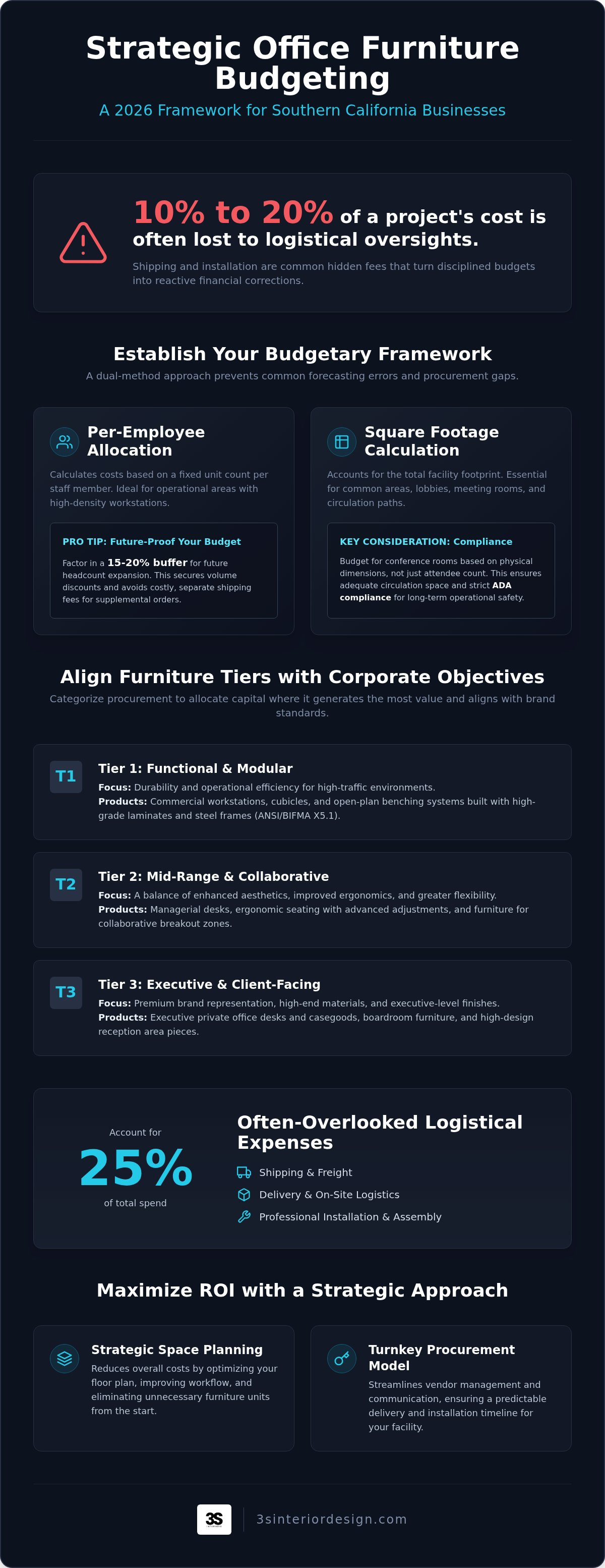
Did you know that logistical oversights like shipping and installation typically add 10% to 20% to a commercial project's total cost? For many Southern California executives, these hidden fees turn a disciplined office furniture budget planning process into a series of reactive financial corrections. You likely recognize that high-quality workstations and ergonomic seating are essential for employee retention; however, the gap between executive expectations and actual delivery costs remains a persistent challenge in the Los Angeles market.
We're providing a professional framework designed to eliminate these unpredictable variables and maximize your workspace ROI. This strategic template aligns your corporate brand with 2026 cost benchmarks, ensuring that every private office desk and conference table fits within a predictable financial model. You'll gain a clear understanding of mid-range and premium price points, local lead times, and the technical specifications required to meet California seating standards. This article outlines the exact steps needed to move from an initial assessment to a seamless installation in Irvine, the Inland Empire, or downtown LA.
Table of Contents
Establishing Your Budgetary Framework: Headcount vs. Square Footage
Effective office furniture budget planning in 2026 requires a dual-method approach to avoid common forecasting errors. Relying solely on a single metric often leads to procurement gaps or unexpected surcharges during the installation phase. Most Southern California businesses utilize two primary frameworks: headcount-based budgeting and square footage-based budgeting. Each serves a distinct purpose within the overall project timeline and helps mitigate the risk of financial overruns.
Headcount-based budgeting serves as the baseline for operational areas, particularly where high-density workstations and cubicles are the primary focus. It allows facility managers to calculate costs based on a fixed unit count per staff member. Conversely, square footage-based budgeting is essential for comprehensive Strategic Office Space Planning. This method accounts for the total footprint of the facility, ensuring that common areas and circulation paths are adequately funded. Many organizations find that the standard "cost-per-employee" model fails to address the specific requirements of executive private offices. Private office desks and casegoods represent a significantly higher investment than standard benching systems, requiring a separate budgetary allocation that accounts for increased material quality and logistical complexity.
The Per-Employee Allocation Model
This model focuses on the individual workspace. For standard staff roles, the base allocation includes ergonomic seating, a desk, and integrated storage. However, the requirements for an executive suite differ in both scale and finish. When you're calculating your 2026 budget, it's vital to factor in a 15-20% buffer for future headcount expansion. Budgeting only for current staff often results in higher per-unit costs later because you'll miss volume discounts and incur separate shipping fees for smaller, supplemental orders that require independent delivery schedules.
The Square Footage Calculation for Common Areas
Common areas like reception lobbies and breakout zones don't scale by headcount, making square footage the more reliable metric. These spaces require specialized reception and lobby furniture that must meet specific durability standards. For meeting spaces, budget for conference room furniture based on the physical dimensions of the room rather than the number of attendees. This ensures the layout accommodates circulation space and strictly adheres to ADA compliance requirements. These accessibility standards are critical for Southern California commercial permits and long-term operational safety.
Quality Tiering: Aligning Furniture Specifications with Corporate Objectives
Strategic office furniture budget planning necessitates a structured approach to quality tiers. Businesses in Southern California must distinguish between functional utility and executive-level brand representation to ensure long-term ROI. Tiering allows you to allocate capital where it generates the most value. It prevents over-investing in back-office areas while ensuring client-facing suites meet professional standards. By categorizing procurement into three distinct levels, facility managers can align furniture specifications with specific departmental needs and corporate objectives.
Tier 1: Functional and Modular Workstations
Tier 1 focuses on operational efficiency and durability. This level is ideal for high-density environments where modularity is paramount. You should prioritize cost-effective commercial workstations and cubicles for departments with high daily usage or high-traffic operational requirements. These systems typically utilize high-grade laminates and steel frames that meet ANSI/BIFMA X5.1 safety standards. In contemporary Southern California layouts, open plan office benching systems play a central role in Tier 1 planning. They provide the flexibility required for hybrid work models while maintaining a lower cost per square foot compared to full-height partitions. These modular systems are designed for rapid reconfiguration, making them a pragmatic choice for growing firms in the Inland Empire or Los Angeles.
Tier 2 & 3: Executive Desks and Brand Impression
Tier 2 and 3 investments target the "flight to quality" trend observed in Los Angeles and Orange County Class A buildings. Professional/Tier 2 options feature enhanced ergonomics and specialized private office desks and casegoods. These products often include wood veneers or high-pressure laminates that resist wear in executive suites. With the standing desk market projected to reach $9.1 billion in 2026, Tier 2 often includes height-adjustable tables that support employee well-being. Tier 3 represents the executive level, where bespoke finishes and premium materials define the corporate brand. These pieces act as anchors for high-impact areas like boardrooms and reception lobbies.
Choosing between ergonomic task chairs vs executive chairs is a critical decision in this phase. While task chairs support long-term health and employee retention, executive seating emphasizes status and comfort during high-stakes meetings. Premium finishes in boardrooms offer a measurable ROI by reinforcing professional authority during client interactions. Facility managers often find that a manufacturer-agnostic approach helps balance these tiers effectively. You can explore customized furniture solutions that fit specific departmental budgets while maintaining a cohesive corporate aesthetic across your entire facility.
Accounting for Logistical Variables: Shipping, Delivery, and Professional Installation
A frequent error in office furniture budget planning is the failure to account for logistical variables that occur after the purchase order is signed. While unit prices are transparent, the costs associated with moving assets into a commercial facility often consume 15% to 25% of the total project budget. These expenses encompass freight, specialized handling, and final assembly. In 2026, supply chain surcharges and fluctuating fuel costs have made shipping a variable expense rather than a fixed one. Relying on outdated estimates can lead to significant financial gaps during the final project phases.
The "high-rise factor" is particularly critical for businesses in downtown Los Angeles or Century City. Your budget must include allowances for elevator access fees, municipal parking permits, and mandatory after-hours delivery windows. These requirements are standard in Class A buildings but are often overlooked by generalists. Professional logistical management ensures these details don't derail your timeline or result in building management penalties.
The Real Cost of Professional Installation
Commercial-grade furniture isn't designed for simplified assembly. It requires specialized leveling to account for floor variances and the integration of complex data and power management systems. Attempting a DIY approach with systems as intricate as professional office cubicle installation Southern California introduces significant risk to both product warranties and employee safety. Utilizing turnkey workspace solutions allows you to consolidate these labor costs into a single, predictable line item. This model ensures that the team responsible for space planning also manages the final execution, eliminating the communication gaps that occur between multiple vendors.
Southern California Logistical Planning
Regional geography dictates your delivery strategy. Projects in Santa Monica, Irvine, or Beverly Hills face unique traffic constraints and local noise ordinances that limit delivery hours. To avoid storage fees and expedited shipping costs, you must align your office furniture budget planning with local manufacturer lead times, which currently average 8 to 12 weeks for custom orders. Local warehousing is a strategic asset here. It allows for phased office build-outs where furniture is staged nearby and delivered only when the site is ready, preventing congestion and damage on the job site.
Maximizing ROI through Strategic Office Space Planning
Professional office space planning services are not merely an aesthetic luxury. In the context of 2026 commercial real estate, these services function as a primary cost-reduction tool. By precisely optimizing your facility's footprint, you can often reduce the total number of physical units required to support your staff. This reduction directly impacts your procurement spend and lowers the associated shipping and installation fees. Integrated space planning ensures that every square foot is utilized with clinical precision, preventing the over-ordering of workstations or storage systems that often plagues unmanaged projects.
Strategic office furniture budget planning also prioritizes multifunctional assets. For instance, using modular components that serve as both workspace and storage can significantly maximize small square footage in tight markets like the Inland Empire. Planning for modular reconfiguration from the start future-proofs your investment. It allows your organization to adapt to changing headcount without requiring a complete furniture overhaul, ensuring that your initial capital expenditure continues to deliver value over a long-term lifecycle.
Space Optimization Strategies
A critical decision involves comparing the financial impact of executive private offices versus open-plan benching systems. While private offices offer acoustic privacy, they require a higher investment in casegoods and architectural finishes. To bridge this gap, facility managers are increasingly using office filing cabinets Los Angeles as structural elements. Placing high-density storage systems as spatial dividers provides the necessary visual privacy for focused work while saving on the costs of permanent wall construction. Visualizing these layouts through professional software before procurement prevents sizing errors that lead to costly returns or field modifications.
Technology and Infrastructure Integration
In mission-critical environments like control rooms or operations centers, this integration extends to specialized visualization hardware. Solutions from Activu Corporation ensure that video wall systems are factored into the initial infrastructure planning to avoid costly post-installation adjustments.
Your furniture layout must align with the building's existing technical infrastructure to remain cost-efficient. High-performance furniture, such as sit/stand and height-adjustable tables, requires specific power and data management. If these units aren't strategically placed near existing floor boxes or wall outlets, the electrical retrofit costs can exceed the furniture budget itself. Proper planning ensures that workstations don't obstruct HVAC vents or lighting sensors, maintaining operational efficiency. This level of coordination directly influences employee productivity and retention, providing a long-term ROI that far exceeds the initial purchase price. If you're ready to optimize your facility's layout, you can schedule a space planning consultation with our logistical experts today.
Executing Your Procurement Strategy: The Turnkey Solution Model
The final phase of office furniture budget planning involves transitioning from a theoretical template to active procurement. Successful execution requires a manufacturer-agnostic approach. This strategy ensures that product selection is driven by your specific budget and functional requirements rather than the limited catalog of a single brand. Just as physical assets require careful coordination, your digital systems must also be aligned with corporate strategy; to achieve this, check out EBSA Consulting for specialized enterprise architecture services. By consolidating procurement, delivery, and installation into a single turnkey project, you'll eliminate the fragmentation that typically leads to project delays. This methodical flow moves from the initial assessment through a structured timeline, concluding in a final walk-through to ensure every workstation and private office desk meets your technical specifications.
Managing multiple vendors introduces significant soft costs that are rarely captured in the initial budget. These costs represent the hundreds of internal staff hours spent on coordination, scheduling, and troubleshooting delivery errors. A commercial partner leverages established manufacturer relationships to secure competitive pricing that individual businesses can't access through direct retail channels. This model provides a single point of accountability. If a warranty issue or a shipping delay occurs, you've one contact responsible for the resolution. This streamlines the process and ensures the logistical burden remains with the expert partner rather than your facility management team.
Finalizing Your 2026 Budget Template
Before finalizing your office furniture budget planning, perform a comprehensive audit of all project line items. In 2026, Southern California projects must account for specific regional variables to remain accurate. Your final template should include:
Total furniture unit costs across all quality tiers.
California sales tax based on the delivery location.
Freight and shipping surcharges, which typically range from 10% to 20%.
Professional installation and assembly labor.
A mandatory 10% contingency fund for unforeseen logistical variables.
Setting a contingency fund is a pragmatic necessity. It covers unexpected "high-rise factors" or site-readiness delays that often occur in Los Angeles or Orange County. Once your template is complete, the next step is scheduling a professional space assessment. This allows for a precise verification of your dimensions and infrastructure, ensuring the procurement phase proceeds without technical errors or sizing mismatches.
Securing Long-Term ROI for Your 2026 Workspace
Mastering office furniture budget planning requires moving beyond unit price comparisons to a comprehensive logistical strategy. You've seen how integrating space planning reduces total unit counts and how accounting for Southern California's specific delivery variables prevents late-stage financial gaps. A successful project relies on aligning quality tiers with your corporate identity while maintaining a strict 10% contingency for the high-rise factors common in Los Angeles and Irvine.
We've served the Los Angeles and Orange County regions for over a decade, providing expert project management from initial procurement to final installation. Our manufacturer-agnostic selection process ensures your furniture fits your specific corporate budget without compromising on durability or brand impact. Consolidating your logistics under a single turnkey partner eliminates the soft costs of managing multiple vendors and secures your timeline.
Take the next step in your facility's evolution. Request a Professional Budget Consultation and Space Plan to ensure your 2026 procurement is precise and risk-free. Your optimized office environment is within reach.
Frequently Asked Questions
What is the average cost per square foot for office furniture in 2026?
Budgeting by square foot varies significantly based on density. For a standard Class A office in Century City or Irvine, furniture costs often range from $15 to $35 per square foot depending on the mix of workstations and private offices. This figure includes the primary desk systems and seating. However, high-density benching systems in open-plan layouts can lower this average, while executive suites with premium casegoods will increase it.
How much should I budget for professional office furniture installation?
You should allocate between 10% and 20% of your total furniture expenditure for professional installation services. This percentage covers the labor required for assembly, leveling, and debris removal at your facility in Santa Monica or Burbank. Complex systems like height-adjustable tables and cubicles with integrated power require more intensive labor. Professional installation ensures that manufacturer warranties remain valid and that all units meet safety standards for commercial use in California.
Are shipping and freight costs usually included in furniture quotes?
Shipping and freight costs are typically listed as separate line items rather than being bundled into the unit price. In 2026, these logistical expenses often account for 10% to 15% of the project total due to fuel surcharges and regional delivery fees. For businesses in high-traffic areas like Beverly Hills or downtown LA, specific delivery windows and parking permits may incur additional surcharges. Always verify if your quote includes "dock-to-dock" or "white-glove" delivery.
How can space planning help reduce my total furniture budget?
Strategic space planning reduces your overall budget by optimizing the floor plan to support your headcount with fewer physical units. By identifying multifunctional pieces and eliminating redundant storage, you lower both procurement and installation costs. A professional layout also prevents costly sizing errors that lead to returns. This methodical approach ensures your office furniture budget planning remains efficient while maximizing the utility of every square foot in your Los Angeles facility.
What is the difference between retail and commercial-grade furniture pricing?
Commercial-grade furniture carries a higher initial price point than retail options because it's engineered for 24/7 use and meets BIFMA safety standards. These products feature heavy-duty laminates and structural steel components that retail furniture lacks. While the upfront investment is higher, the total cost of ownership is lower because commercial pieces include 10 to 12-year warranties. This durability is essential for Southern California businesses that prioritize operational stability and long-term asset value.
Do I need to budget for electrical and data integration separately?
Yes, you must budget for the electrical and data connections that link your furniture to the building's infrastructure. While workstations often include internal cable management and power strips, a licensed electrician must perform the final "whip" connection to the floor boxes. This labor is usually a separate expense from the furniture installation. Coordination between your furniture provider and IT team is critical to ensure that height-adjustable tables and workstations have adequate power access.
Should I prioritize ergonomic chairs or high-end desks in my budget?
You should prioritize high-quality ergonomic office seating to support employee health and long-term retention. Research indicates that supportive seating reduces workplace injuries and increases productivity, providing a higher ROI than aesthetic desk upgrades. While a private office desk defines your brand's image, the chair directly impacts daily operational performance. A balanced office furniture budget planning strategy allocates more funds to seating for staff who spend the majority of their day at a workstation.
How long does the procurement and installation process typically take?
The entire process from initial consultation to final installation typically spans 8 to 12 weeks. This timeline includes the space planning phase, manufacturer lead times for custom orders, and the logistical coordination required for delivery in Southern California. Standard, quick-ship items may arrive in 2 to 4 weeks, but high-volume workstations or executive casegoods require longer production cycles. Planning at least one quarter in advance helps you avoid expedited shipping fees and scheduling conflicts.


Comments