


Professional Conference Room Chair Guide 2026
The National Institute of Health reports that poor seating contributes to over 86% of workplace-related musculoskeletal disorders. You likely recognize that a boardroom is more than just a functional space; it's a high-stakes environment where corporate identity is solidified and critical decisions are made. Many Southern California facility managers find that employee fatigue during extended meetings and mismatched furniture can quickly undermine a firm's professional image. Understanding how to choose chairs for a conference room requires a methodical approach that prioritizes both long-term physical support and logistical precision.
This guide provides a strategic framework to select seating that balances ergonomic requirements, spatial efficiency, and your specific corporate aesthetic. We'll show you how to secure long-lasting furniture that meets current ANSI/BIFMA X5.1-2017(R2022) standards while ensuring a seamless installation process. We will detail technical specifications for various price points, provide formulas for calculating chair density based on room dimensions, and outline a project management path that eliminates operational downtime for your office.
Table of Contents
Identifying the Strategic Purpose of Your Conference Space
Selecting furniture begins with a functional audit of the room's primary objective. A space designed for quick internal scrums requires different logistical considerations than a boardroom intended for high-stakes client presentations. When determining how to choose chairs for a conference room, you must first evaluate the visitor profile and the expected frequency of use. High-traffic areas in active Southern California hubs often benefit from durable, easily cleaned materials, while private executive suites require a finish that reflects corporate prestige. Strategic space planning ensures that the seating density doesn't compromise the professional atmosphere or the comfort of participants.
Mobility is another critical factor in your selection process. Fixed boardrooms utilize heavy, high-specification seating to anchor the room's formal environment. In contrast, flexible training spaces or multi-purpose rooms require chairs that are easily reconfigured. This flexibility allows facility managers to maximize the utility of their square footage without compromising on professional standards. Every chair must serve the room's specific workflow, whether that involves static listening or active, collaborative movement.
Internal Collaboration vs. Executive Boardrooms
Creative agencies in Santa Monica often prioritize mobility and lightweight designs to support spontaneous brainstorming sessions. These teams value agility and often select seating that can be moved quickly between workstations and huddle rooms. Conversely, law firms or financial institutions in Century City typically require high-back executive chairs that project authority and provide substantial support for formal depositions. Balancing a uniform aesthetic across the entire office while meeting these varied functional needs is a core component of a successful procurement strategy. It's possible to maintain a cohesive brand image by selecting different chair models from the same manufacturer that share similar design languages.
Meeting Duration and User Fatigue
Meeting length directly dictates the necessary mechanical complexity of the seating. For short 30-minute huddles, basic swivel chairs may suffice to keep the energy high and the transition quick. However, intensive four-hour strategy sessions demand advanced ergonomic features of office chairs to mitigate user fatigue and maintain participant focus. Poorly selected seating leads to physical discomfort, which distracts from the meeting's agenda and reduces overall operational efficiency. Investing in higher-specification chairs for long-duration spaces protects the health of employees and ensures that the most critical business discussions aren't cut short by physical strain. Understanding these nuances is essential when deciding how to choose chairs for a conference room that will be used for high-stakes decision-making.
Evaluating Ergonomic Features and Mechanical Specifications
Mechanical specifications determine the longevity of your investment and the physical well-being of your team. While a dedicated task chair for a personal workstation may feature ten or more adjustment points, understanding how to choose chairs for a conference room requires a different focus. In a shared environment, users change frequently. Complex manual controls often lead to frustration or incorrect setup. Instead, prioritize intuitive mechanisms that accommodate a wide range of body types without requiring extensive training.
Commercial-grade durability is non-negotiable for high-traffic Southern California offices. Look for products that meet the ANSI/BIFMA X5.1-2017(R2022) standard. This certification ensures the chair's safety, structural adequacy, and durability, including a reference user weight capacity of 275 lbs. Beyond structural integrity, evaluate the seat pan design. A waterfall edge, which slopes slightly downward at the front of the seat, is essential for maintaining leg circulation during long sessions. Proper seat pan depth and integrated lumbar support further reduce pressure on the lower back, ensuring participants stay alert throughout the meeting.
Adjustability vs. Simplicity
In shared spaces, excessive adjustment levers are often counterproductive. Weight-sensitive recline mechanisms are the gold standard for modern conference rooms. These systems automatically calibrate the tension based on the user's weight, providing immediate support without manual intervention. Standard pneumatic lifts are also vital. They allow participants to align their forearms with the table surface, regardless of their height or the specific dimensions of your conference room furniture.
Base and Caster Specifications
The foundation of the chair must match your specific flooring requirements. Five-star bases provide the necessary stability for 360-degree swivels. This feature is crucial for maintaining eye contact and facilitating natural transitions between speakers. In many Los Angeles office buildings, flooring types vary from high-pile carpet to polished concrete. Selecting the correct caster is critical: soft casters are necessary for hard surfaces to prevent skidding and floor damage, while hard casters provide the required mobility on carpeted surfaces. Sled bases are an alternative for static environments, though they don't provide the dynamic mobility required for active collaborative sessions.
Selecting Materials for Durability and Corporate Branding
Material selection is a critical logistical decision that dictates the long-term maintenance cycle of your conference room. When evaluating how to choose chairs for a conference room, you must balance immediate visual prestige with technical performance specifications. High-traffic commercial spaces in Southern California require materials that withstand frequent use while adhering to strict safety regulations. All upholstered furniture must meet 16 CFR Part 1640, which references the California Technical Bulletin (TB) 117-2013 flammability standards. Selecting compliant cover fabrics and resilient filling materials is a fundamental step in mitigating professional risk.
Durability is measured by the Wyzenbeek abrasion test. For high-use boardroom environments, prioritize fabrics rated for at least 50,000 double rubs. Additionally, verify that surfaces meet BIFMA G8.1-2026 guidelines for durability against cleaning and sanitizing agents. While genuine leather offers a high level of prestige and ease of maintenance, high-performance synthetic alternatives like polyurethane (PU) provide similar aesthetics. Frame finishes, including chrome, matte black, or wood veneers, should be coordinated with your existing furniture to maintain a unified corporate image. This coordination ensures that the boardroom remains a cohesive extension of the firm’s brand identity.
Mesh vs. Upholstered Seating
Mesh seating is a preferred choice for modern tech environments in hubs like Irvine or Silicon Beach. It offers superior climate control efficiency, which is essential for maintaining comfort during Southern California's warmer months. However, upholstered seating remains the standard for executive boardrooms due to its classic appeal and superior acoustic dampening. As hybrid meetings become the norm, reducing echo and background noise is vital. Statistics show 75% of remote workers struggle with audio clarity; upholstered furniture helps absorb sound, improving the experience for both in-person and remote participants.
Color Psychology and Brand Identity
Neutral tones like charcoal, navy, or slate offer maximum versatility for multi-use spaces. These colors allow the room to adapt to various meeting types without feeling dated. If you wish to integrate brand colors, do so through subtle accents or specific stitching rather than overwhelming the entire room design. It is strategically important to match chair frames and hardware to your private office desks and casegoods to create a seamless transition between individual workspaces and collaborative zones. This methodical approach to color and finish coordination projects an image of a highly organized and professional entity.
Calculating Capacity and Spatial Layout Requirements
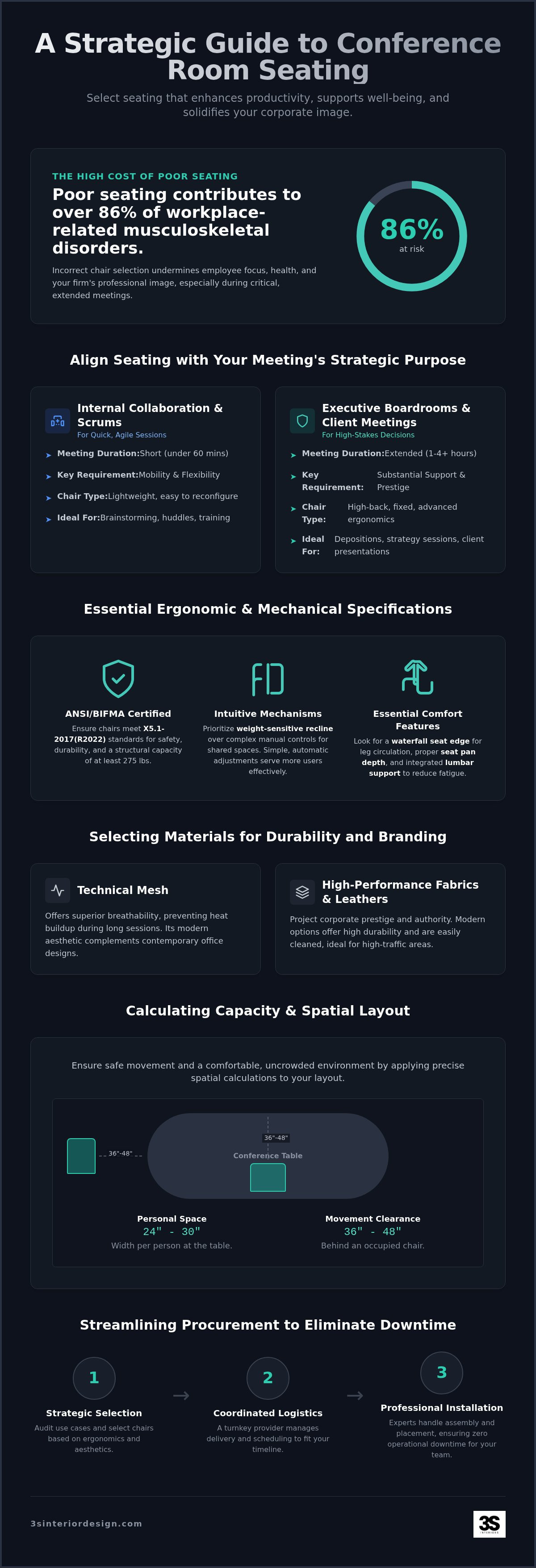
Spatial efficiency is a primary driver of meeting productivity. When determining how to choose chairs for a conference room, you must calculate the precise footprint of each unit relative to the table length and room perimeter. A common error is selecting oversized executive chairs that crowd the table, forcing participants into close proximity that can hinder professional focus. Effective layouts require a balance between maximum capacity and the logistical necessity of clear ingress and egress routes. You should maintain at least 36 to 48 inches of clearance between the back of a seated chair and the nearest wall or piece of perimeter furniture. ADA standards must also be integrated into the initial layout to ensure the space remains accessible and compliant with federal regulations. This includes maintaining a 60-inch turning diameter for wheelchair maneuverability within the room.
Standard Spacing and Elbow Room
The 30-inch rule is the industry benchmark for high-stakes negotiation environments. This measurement, taken from the center of one chair to the next, provides the necessary personal space for participants to review documents and utilize laptops without physical interference. Armrest width significantly impacts this calculation; wider executive models may reduce the total chair count by 15% to 20% compared to slim-profile task seating. For V-shaped or U-shaped configurations, you must account for the additional clearance needed at the corners to prevent "dead zones" where chairs become physically locked together. These specialized layouts often require a higher ratio of square footage per person but offer superior sightlines for video conferencing and digital presentations.
Professional Space Planning Services
A methodical procurement process includes 2D and 3D renderings to visualize the final installation before any capital is committed. These digital models allow facility managers to identify sightline obstructions for AV equipment and ensure that presentation screens remain visible from every seat. Utilizing commercial office space planning identifies potential bottlenecks in the room flow that a simple furniture catalog cannot reveal. Strategic planning ensures that the furniture doesn't just fit the room, but actually enhances the operational efficiency of the users. This proactive approach prevents costly post-installation adjustments and ensures the room functions as a well-oiled machine from day one. If you are ready to optimize your boardroom layout, contact us at 3S Interior Design to begin your spatial assessment.
Streamlining Procurement and Professional Installation
The final phase of a workspace upgrade involves a complex logistical transition from selection to active use. Understanding how to choose chairs for a conference room is only the first step; the subsequent procurement and installation process must be managed with precision to protect your investment. Manufacturer-agnostic procurement allows for budget optimization by selecting the best-performing units across various brands rather than being restricted to a single catalog. This approach ensures that your executive boardroom furniture meets high-level specifications without unnecessary markup or compromise on quality.
Coordinated delivery schedules are essential to minimize operational downtime. A typical timeline begins with an initial consultation and space audit, followed by procurement and a staged delivery process. Professional installation teams handle the physical assembly and placement, ensuring that every unit functions according to its mechanical specifications. This methodical oversight prevents the common errors associated with unmanaged retail deliveries, such as damaged components or incorrect assembly that could void manufacturer warranties. By managing the transition from order to placement, you ensure the project remains on schedule and within the established budget.
The Turnkey Advantage for Southern California Businesses
Managing logistics across multiple locations, from Irvine to Burbank, requires a centralized project management model. Turnkey solutions provide a single point of contact for all phases of the installation, reducing the administrative burden on your facility managers. Professional assembly is not merely a convenience; it's a requirement for maintaining long-term warranty compliance and ensuring user safety. Following the physical setup, a comprehensive post-installation walkthrough ensures that every chair meets the firm's quality standards. This quality assurance phase confirms that the spatial layout matches the original renderings and that all ergonomic mechanisms are fully operational.
Budgeting for Commercial Quality
Strategic budgeting focuses on the Total Cost of Ownership (TCO) rather than the initial purchase price. High-quality, BIFMA-certified furniture reduces replacement frequency and maintenance costs over a five-to-ten-year cycle. Growing firms can often leverage volume discounts by coordinating boardroom upgrades with other office seating needs. It's important to recognize that ergonomic task chairs vs executive chairs require different budget allocations based on their mechanical complexity and material finish. Allocating funds based on the strategic importance of the space ensures that your most visible meeting rooms receive the highest level of investment. This comprehensive approach to procurement guarantees that your boardroom remains a functional, professional asset for years to come.
Optimizing Your Corporate Meeting Environment
Selecting the correct seating is a strategic investment that impacts both the physical health of your team and the professional image of your firm. By prioritizing BIFMA-certified mechanical specifications and coordinating material finishes with existing casegoods, you establish a boardroom that is both functional and prestigious. Mastering how to choose chairs for a conference room requires a methodical focus on spatial efficiency, ensuring that every participant has the necessary clearance and support for high-stakes decision-making. These logistical details prevent user fatigue and maintain a cohesive brand identity across your entire Southern California office.
3S Interior Design has served the Southern California region for over a decade, providing commercial-grade furniture curated for the highest professional standards. Our turnkey service model includes expert space planning and professional installation to ensure your project is executed without operational downtime. We manage the complex details of procurement and assembly so you can focus on your core business objectives. We invite you to Request a Professional Conference Room Consultation to begin your workspace transformation. Your office deserves a layout designed for long-term stability and success.
Frequently Asked Questions
How much space should be left between conference room chairs?
The industry standard for high-stakes environments is 30 inches center-to-center. This measurement provides adequate personal space for laptops and document review without physical interference. When determining how to choose chairs for a conference room, factor in the armrest width of your selected model. Oversized executive units may require up to 36 inches center-to-center to prevent crowding. Maintaining these clearances ensures participant focus remains on the meeting agenda rather than physical discomfort.
Are chairs with wheels better for conference rooms?
Caster-based chairs are generally superior for conference environments due to the mobility and swivel capabilities they provide. They facilitate 360-degree rotations, which are essential for maintaining eye contact with various speakers around the table. However, the choice of caster must match your flooring type. Hard casters are necessary for carpeted Southern California offices, while soft casters protect hard surfaces like polished concrete or wood from skidding and permanent structural damage.
What is the standard height for a conference room chair?
The standard seat height for professional conference seating ranges from 16 to 21 inches from the floor. Most commercial-grade chairs utilize pneumatic lifts to allow users to align their forearms parallel to the table surface. This adjustability is critical because table heights can vary slightly between manufacturers. Ensuring your seating accommodates diverse body types is a foundational step in your procurement strategy to maintain long-term operational stability and employee health.
Should I choose mesh or leather for a professional boardroom?
Mesh is ideal for tech-oriented spaces requiring climate control efficiency and breathability in warmer climates. Conversely, leather or high-performance upholstery is preferred for executive boardrooms due to its prestige and acoustic dampening properties. Since 75% of remote workers report audio issues during hybrid calls, upholstered seating can help by absorbing ambient sound. Your choice should reflect the specific visitor profile and the level of authority your firm intends to project.
How do I know if a conference chair is BIFMA certified?
Verification of BIFMA certification is found in the manufacturer's technical data sheets or on a label located under the seat pan. Look specifically for the ANSI/BIFMA X5.1-2017(R2022) designation for general-purpose office chairs. This standard confirms the unit has passed rigorous safety and durability testing, including weight capacity assessments for a reference user of 275 lbs. Certified furniture reduces the professional risk of structural failure in high-traffic corporate spaces.
Can I use task chairs for a conference room?
Task chairs can be used in conference rooms, provided they feature intuitive, simplified controls. In shared environments, avoid models with excessive manual adjustment levers that might frustrate users. Weight-sensitive recline mechanisms are more effective because they automatically calibrate tension for the user's weight. When evaluating how to choose chairs for a conference room, prioritize mechanical simplicity to ensure that meetings aren't delayed by participants struggling to configure their seating for basic comfort.
What is the best chair for a small conference room?
Mid-back chairs with a slim profile are the most effective choice for smaller meeting spaces. These designs provide necessary lumbar support without the large visual footprint of a high-back executive chair, which can make a small room feel congested. Armless models or those with fixed, narrow arms further maximize table capacity. Selecting furniture that respects the room's scale ensures the environment remains professional and doesn't hinder participant movement or room ingress.
How many chairs fit around a 10-foot conference table?
A 10-foot conference table typically accommodates 8 to 10 participants depending on the chair width. If you select slim-profile task chairs, you can comfortably fit four people on each side and one at each end. However, if you opt for wide executive seating, you'll likely be limited to three people per side to maintain the 30-inch spacing rule. Precise space planning is required before procurement to ensure the chair count matches the table's physical capacity.


Comments