


The Strategic Office Furniture Procurement Process: A 2026 Management Guide
Updated: Sep 10
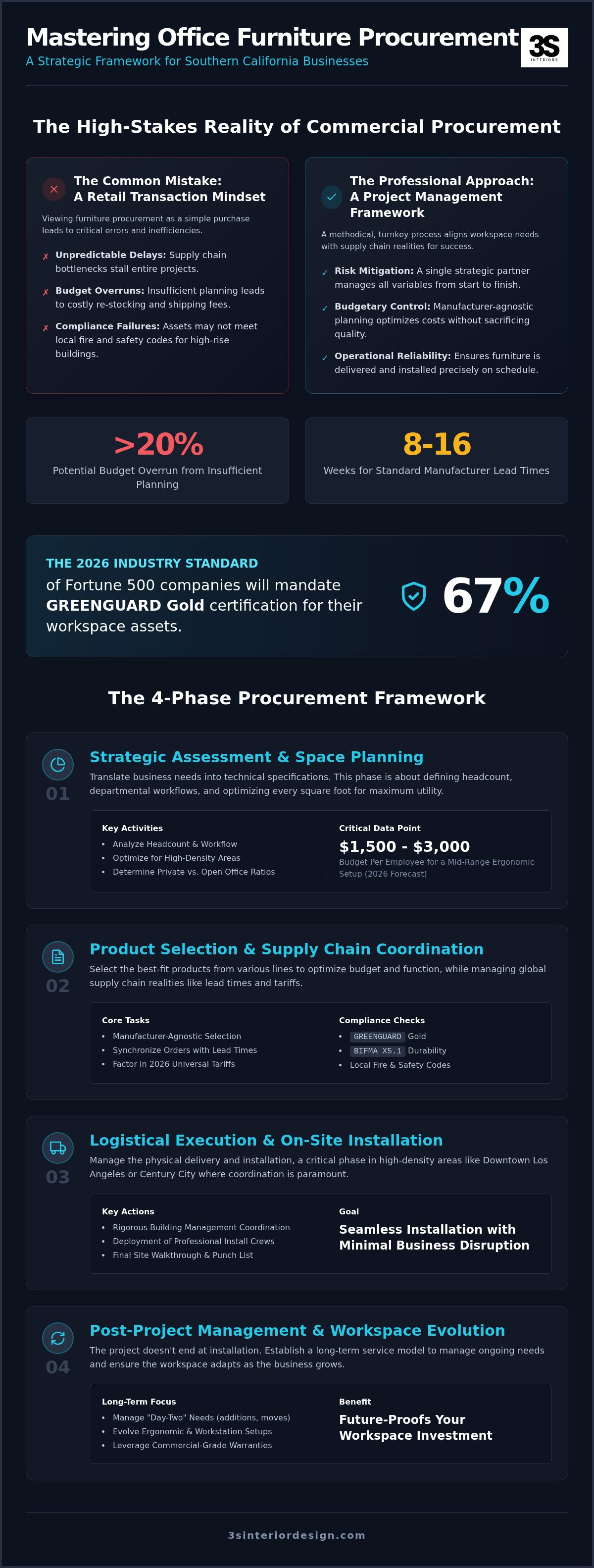
In 2026, 67% of Fortune 500 companies mandate GREENGUARD Gold certification for their workspace assets, yet many Southern California firms still treat the office furniture procurement process as a simple retail transaction rather than a high-stakes logistical operation. This strategic oversight often results in unpredictable manufacturer lead times and budget overruns that can exceed 20% due to insufficient planning. Managing a corporate build-out in high-density regions like Los Angeles or Irvine requires more than an aesthetic vision; it demands a rigorous, manufacturer-agnostic strategy that prioritizes operational reliability and risk mitigation.
You recognize that a single supply chain bottleneck can stall an entire office relocation or expansion. Our objective is to help you master these complexities through a methodical project management framework designed for the regional demands of Southern California. This guide provides the technical roadmap necessary for accurate budget forecasting and seamless installation. We will outline the essential phases of procurement, covering everything from the impact of 2026 universal tariffs to BIFMA X5.1 compliance standards, ensuring your project concludes on schedule with minimal business disruption.
Table of Contents
Defining the Office Furniture Procurement Process
The office furniture procurement process is a high-stakes project management workflow. It isn't a simple retail transaction; it's a strategic sequence that aligns physical workspace requirements with global supply chain realities. While retail purchasing focuses on immediate availability and aesthetic preference, contract furniture procurement involves technical specifications, long-term durability standards, and manufacturer lead times that can span 8 to 16 weeks. It's a comprehensive procurement process that manages every variable from initial space assessment to the final site walkthrough.
A turnkey approach ensures that every phase of this cycle is managed by a single strategic partner. This model provides an end-to-end service that reduces operational risk for the client. By consolidating the various stages of the office furniture procurement process, businesses ensure that the final workspace aligns with both functional requirements and budgetary constraints. This method prioritizes logistical reliability over creative flair, ensuring that the furniture isn't just visually appealing but also functionally sound and delivered on schedule.
Why Commercial Procurement Requires a Methodical Approach
Executing a workspace build-out without a methodical framework leads to costly errors. Mismatched finishes or incorrect product specifications can derail a project timeline and inflate budgets by 10% to 20% due to shipping and re-stocking fees. In high-density regions like Southern California, compliance is another critical factor. While verifying your entity's legal status through the Secretary of State Directory is a standard administrative step for any firm, professional procurement ensures all assets meet local fire and safety codes, such as those governing high-rise occupancy in Downtown Los Angeles or Century City. Manufacturer-agnostic planning is essential here; it allows for budget optimization by selecting the best-fit products across various lines rather than being restricted to a single brand’s price point.
A professional dealer acts as a specialized bridge between interior design concepts and logistical execution. They provide a single point of contact for multiple furniture lines, managing everything from Private Office Desks & Casegoods to Ergonomic Office Seating. This partnership grants facility managers access to exclusive commercial-grade warranties that aren't available through standard retail channels. By overseeing the details of order tracking and delivery coordination, the dealer mitigates the risk of business disruption. They ensure that furniture arrives and is installed precisely when the site is ready, maintaining the continuity of the project timeline.
Phase 1: Strategic Assessment and Space Planning
The office furniture procurement process begins with a precise calculation of operational needs. This assessment isn't about choosing colors; it's about defining headcount, departmental workflows, and cultural requirements. A facility manager must determine how many employees require dedicated desks versus collaborative zones. Every square foot in high-rent districts like Santa Monica or Irvine must be optimized for maximum utility. This phase translates vague design concepts into technical furniture specifications that serve as the foundation for the entire project timeline.
Establishing a tiered budget forecast is a critical component of this initial assessment. As of 2026, mid-range ergonomic setups typically require a budget of $1,500 to $3,000 per employee. By categorizing needs into budget tiers, decision-makers can allocate funds strategically, ensuring that high-traffic areas like lobbies receive premium assets while back-office functions remain cost-effective. Engaging a strategic partner for Space Planning & Layout Design early in the project ensures that these technical requirements align with your long-term budgetary goals.
Analyzing Workplace Dynamics
Determining the correct ratio of Workstations & Cubicles to private offices is the first step in physical planning. Modern workflows often demand a mix of open-plan benching systems and secluded focus areas. You must also assess the need for specialized Conference Room Furniture that supports hybrid meeting technology. Since 67% of Fortune 500 companies now require GREENGUARD Gold certification for furniture, identifying these ergonomic and environmental requirements during the assessment phase prevents costly re-specifications later in the cycle.
The Technical Blueprint
The transition from assessment to order placement requires a technical blueprint. By utilizing CAD and 3D renderings, we eliminate field measurement errors that often lead to installation-day crises. This process ensures that Sit/Stand & Height-Adjustable Tables have the necessary clearance and access to integrated power and data sources. Technical space planning prevents 90% of procurement delays by ensuring physical compatibility and power alignment before any capital is committed. This blueprint acts as the final filter, confirming that the selected assets fit the physical constraints of the building and the operational needs of the team.
Phase 2: Product Selection and Supply Chain Coordination
Once the technical blueprint is finalized, the office furniture procurement process shifts toward physical asset curation. We utilize a "Good, Better, Best" framework to categorize selections, allowing facility managers to prioritize spending on high-impact areas while maintaining a consistent standard across the floor plate. Every selection must survive a dual-filter test: it must meet the brand's aesthetic standards and the manufacturer's production schedule must align with the occupancy date. Missed acknowledgment dates from a manufacturer can push an entire delivery window back by several weeks, so we track production milestones with clinical precision.
Curation involves more than picking a style. When selecting Private Office Desks & Casegoods, we look for materials that communicate corporate authority while offering modular flexibility for future reconfigurations. We act as the bridge between your vision and the factory floor, ensuring that every piece of furniture meets the rigorous durability requirements of a commercial environment. This phase is where we lock in the specifications that will define your workspace for the next decade.
Curating a Professional Aesthetic
Consistency is the hallmark of a professional environment. We ensure that textiles and finishes used in workstations are echoed in the Reception & Lobby Furniture to create a unified brand experience. This continuity extends to utilitarian assets like Storage & Filing Systems. These pieces shouldn't look like afterthoughts; they should integrate seamlessly into the overall architectural envelope of the office. We prioritize high-performance laminates and commercial-grade veneers that withstand the daily rigors of a busy Southern California office.
Supply Chain Management
Managing the supply chain requires proactive oversight of global shipping trends and local logistics. For Southern California projects, we monitor the ports of Los Angeles and Long Beach for potential congestion that could impact the final mile. To mitigate these risks, we employ several strategic coordination methods:
Consolidating orders from multiple manufacturers into a single local warehouse to ensure a one-time delivery window.
Identifying "Quick Ship" programs that offer 2 to 4 week lead times for urgent expansion needs or rapid office build-outs.
Establishing firm production milestones with factory representatives to verify that materials are on-site and ready for assembly.
Proactively communicating potential delays to stakeholders to adjust installation schedules before they become critical.
This logistical rigor prevents the "staggered delivery" nightmare where desks arrive weeks before the seating. By synchronizing the supply chain, we maintain the project's momentum toward a successful, on-time installation.
Phase 3: Logistical Execution and On-Site Installation
Logistical execution represents the most volatile stage of the office furniture procurement process. Success here depends on precise synchronization between freight carriers, building management, and the assembly crew. In high-density hubs like Century City or Downtown Los Angeles, building access is strictly regulated. You can't simply pull a truck up to the curb. We manage the complex requirements of Class-A office buildings, ensuring that every logistical hurdle is cleared before the first piece of furniture arrives on-site.
The "Last Mile" of delivery is where many projects fail due to poor planning. Navigating the 405 or the 101 with a full load of casegoods requires strategic timing. We coordinate with building managers to secure freight elevator access and loading dock reservations well in advance. This phase concludes with a final punch-list walkthrough. We verify that every desk, chair, and storage unit is placed according to the CAD blueprint and functions exactly as intended.
Southern California Installation Logistics
Building managers in major Los Angeles business districts enforce rigid operational standards. We handle the submission of comprehensive Certificates of Insurance (COI) that meet specific property requirements. To minimize business downtime, we often schedule Office Furniture Installation during overnight hours or weekends. This approach ensures that your team leaves an empty space on Friday and returns to a fully functional office on Monday morning. Loading dock schedules are managed with minute-by-minute precision to avoid city-mandated idling fines or access denials.
On-Site Quality Control
Quality control begins the moment the truck doors open. Our team inspects all casegoods and seating for transit damage before they enter the building. We provide professional assembly for technically demanding Open Plan & Benching Systems, ensuring that all power and data components are correctly integrated. Professional installation is mandatory to maintain the validity of commercial-grade warranties, as manufacturer coverage often excludes damage resulting from non-certified assembly.
If you're planning a build-out in Southern California, contact us to secure a professional furniture installation team that understands the logistical demands of your specific building.
Post-Project Management and Workspace Evolution
The conclusion of a physical installation isn't the end of the office furniture procurement process; it marks the transition into a long-term asset management phase. A strategic partner remains engaged to address "day-two" needs, which include minor reconfigurations, additional seating orders, and the management of manufacturer warranty claims. Maintaining the integrity of your Ergonomic Office Seating is a continuous requirement. Regular inspections ensure that every chair continues to meet BIFMA standards and provides the necessary support for your staff, directly influencing workplace health and operational efficiency.
Scalability is a critical consideration for businesses expanding within Southern California. Whether you're adding headcount in Irvine or opening a satellite office in Valencia, your procurement strategy must support rapid growth without sacrificing quality. We help you establish standardized furniture specifications that can be replicated across multiple locations. This consistency simplifies future procurement cycles and reinforces your corporate identity. High-quality furniture isn't just a capital expense; it's a tool for employee retention that demonstrates a long-term commitment to the professional well-being of your team.
Lifecycle Asset Management
Effective lifecycle management depends on accurate data. We help clients maintain a digital inventory of all procured furniture assets, tracking everything from purchase dates to specific textile codes. This documentation is invaluable for insurance purposes and future office reconfigurations. By standardizing your specifications, you eliminate the guesswork for future facility managers. We also recommend scheduling periodic ergonomic assessments. These sessions ensure that height-adjustable tables and task chairs are correctly calibrated for individual users, maximizing the return on your ergonomic investment.
Adapting to Hybrid Work Realities
Workplace requirements are rarely static. As hybrid work models evolve, your physical layout must adapt to support more collaborative, technology-driven interactions. We assist in reconfiguring traditional workstation layouts into flexible "huddle" spaces or open-plan benching systems that accommodate fluctuating headcounts. This evolution includes integrating technology-ready conference furniture that supports seamless digital connectivity. If you're ready to streamline your long-term workspace strategy, contact 3S Interior Design for a turnkey consultation to ensure your office remains a high-performance environment.
Optimizing Your Workspace for 2026 and Beyond
Mastering the office furniture procurement process requires a fundamental shift from viewing furniture as a commodity to treating it as a critical infrastructure project. Success depends on the early alignment of technical space planning with current supply chain realities. By implementing a manufacturer-agnostic framework, your organization can mitigate the risks of budget overruns and logistical failures. This methodical approach ensures that every workstation and private office suite supports your team's operational efficiency while adhering to 2026 sustainability and safety standards.
3S Interior Design provides the specialized expertise needed to navigate the unique challenges of the Southern California market. From managing freight elevator reservations in Downtown Los Angeles to coordinating large-scale installations in Irvine, we offer comprehensive project management from initial planning to final walkthrough. Our expertise in high-end private office and corporate systems allows you to maintain focus on your core business while we manage the logistical details. Schedule a Strategic Procurement Consultation with 3S Interior Design today. We're ready to help you build a workspace that evolves with your company's growth.
Frequently Asked Questions
How long does the office furniture procurement process typically take?
The standard office furniture procurement process typically requires 8 to 16 weeks from initial consultation to final installation. This timeline varies based on whether you select direct factory sourcing, which averages 12 to 16 weeks, or wholesale distribution, which often delivers in 2 to 4 weeks. Early engagement allows our team to synchronize these lead times with your construction or relocation schedule, preventing costly downtime during the final stages of your project.
What are the hidden costs in office furniture procurement?
Hidden costs often include shipping and installation fees, which typically add 10% to 20% to the total project budget. In 2026, universal tariffs on imported goods can also increase costs by 10% to 25% depending on the material origin. Other expenses may involve building protection requirements, after-hours labor premiums for high-rise access, and local disposal fees for packaging materials. We provide transparent forecasting to identify these variables before you commit capital.
Why should I use a furniture dealer instead of buying direct?
Working with a professional dealer provides a single point of contact for multiple furniture lines and ensures access to exclusive commercial-grade warranties. Manufacturers often lack the logistical infrastructure to manage on-site assembly and local building requirements. We act as a strategic partner, managing the technical bridge between space planning and physical delivery. This manufacturer-agnostic approach allows us to optimize your budget by selecting the best-fit assets across various brands rather than a single line.
How do I calculate the budget for a new office build-out?
Calculating a budget requires establishing a tier-based approach based on employee headcount. For a complete ergonomic setup in 2026, mid-range budgets typically fall between $1,500 and $3,000 per person, while premium executive tiers can exceed $5,000. It's essential to allocate an additional 15% to 20% for logistical expenses like freight and professional assembly. Our space planning services help you visualize these costs across your floor plate to ensure accurate financial forecasting.
What are current manufacturer lead times for office desks in 2026?
Current manufacturer lead times for custom commercial desks in 2026 average 12 to 16 weeks for factory-direct orders. If your project requires a faster turnaround, wholesale distribution channels offer standardized options with lead times of 2 to 4 weeks. High-volume orders for open-plan benching systems generally require a minimum of 8 to 12 weeks for production. We monitor these timelines daily to ensure your procurement strategy aligns with your physical site readiness.
Do you handle furniture installation in Santa Monica and Beverly Hills?
Yes, we provide comprehensive furniture installation services across Santa Monica, Beverly Hills, and the greater Los Angeles area. Our team manages the specific logistical requirements of Class-A office buildings, including freight elevator reservations and the submission of detailed Certificates of Insurance (COI). We frequently execute overnight or weekend installations in high-traffic hubs like Century City to ensure your business operations remain uninterrupted. Our local expertise ensures compliance with all municipal building and safety codes. For property owners looking to further enhance their facility's infrastructure, read more about AI-powered security and surveillance solutions for Beverly Hills estates.
Can you help with space planning if we already have some furniture?
A turnkey workspace solution from 3S Interior Design includes every phase of the office furniture procurement process. This end-to-end model covers initial consultation, space planning, product curation, and order management. We also handle the physical logistics of delivery and professional on-site installation. By consolidating these services under a single strategic partner, you reduce the risk of specification errors and ensure a seamless transition from an empty shell to a fully functional corporate environment.


Comments